

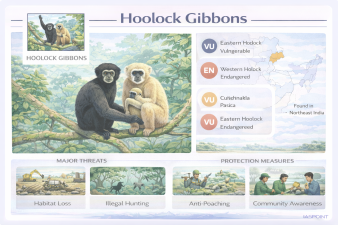
The Hoolock Gibbon is the only ape species found in India. Belonging to the family Hylobatidae (lesser apes), they are renowned for their high-pitched vocalizations and incredible agility. In India, they are exclusively found in the tropical evergreen and semi-evergreen forests of the Northeast. They are distinguished from “Great Apes” (like Gorillas or Chimps) by their smaller size and lack of nest-building behavior.
Taxonomic Classification and Distribution
In India, the genus Hoolock is represented by two distinct species, separated geographically by the Brahmaputra-Dibang river system.
- Western Hoolock Gibbon (Hoolock hoolock): Found in all seven Northeastern states (Assam, Arunachal Pradesh, Manipur, Meghalaya, Mizoram, Nagaland, and Tripura). Its range extends into eastern Bangladesh and northwestern Myanmar.
- Eastern Hoolock Gibbon (Hoolock leuconedys): In India, it is restricted to specific pockets in eastern Arunachal Pradesh (Lohit and Dibang Valley) and the Sadiya subdivision of Assam. It is more common in Myanmar and southern China.
- Mishmi Hills Hoolock Gibbon: A newly described subspecies (H. hoolock mishmiensis) found in the Mishmi Hills of Arunachal Pradesh.
Conservation Status and Legal Protection
Both species face significant threats from habitat fragmentation and hunting, leading to high-level protection under law.
| Framework | Western Hoolock Gibbon | Eastern Hoolock Gibbon |
| IUCN Red List | Endangered | Vulnerable |
| Wildlife Protection Act, 1972 | Schedule I | Schedule I |
| CITES | Appendix I | Appendix I |
| State Symbol | State Animal of Arunachal Pradesh | — |
Physical and Behavioral Traits
- Sexual Dimorphism: While similar in size (60–90 cm), they differ in color. Males are entirely black with white brows. Females are copper-tan or grey-brown with dark patches on the chest and neck.
- Brachiation: They use their exceptionally long arms to swing from branch to branch, a movement called brachiation. They can cover up to 6 meters in a single swing and reach speeds of 55 km/hr.
- Monogamy: Unlike many primates, Hoolock Gibbons form lifelong monogamous pairs and live in small family units.
- Vocalizations: They perform “duets” early in the morning to mark their territory and strengthen pair bonds. These calls can be heard from over 2 km away.
- Diet: Primarily frugivorous (fruit-eating), but they also consume leaves, shoots, and insects.
Key Protected Areas and Habitats
- Hollongapar Gibbon Sanctuary (Assam): Formerly known as the Gibbon Wildlife Sanctuary, it is the only sanctuary in India named after a primate. It is a “forest island” surrounded by tea gardens and railway tracks.
- Namdapha National Park (Arunachal Pradesh): A critical habitat for both Western and Eastern Hoolock Gibbons.
- Dihing Patkai National Park (Assam): Often called the “Amazon of the East,” it provides a vital canopy for gibbon movement.
- Nokrek Biosphere Reserve (Meghalaya): A major stronghold for the Western Hoolock Gibbon in the Garo Hills.
Major Threats and Conservation Challenges
- Habitat Fragmentation: Linear infrastructure like the Mariani-Dibrugarh railway line in Assam bisects habitats. Since gibbons are strictly arboreal (tree-dwelling), they rarely descend to the ground, making even a narrow track an impassable barrier.
- Canopy Bridges: To mitigate fragmentation, the Northeast Frontier Railway and Wildlife Institute of India (WII) have installed artificial canopy rope bridges to facilitate movement.
- Shifting Cultivation (Jhum): Large-scale forest clearing for agriculture in the Northeast reduces the available canopy.
- Hunting: Historically hunted by some indigenous communities for food or traditional medicine, though community-led conservation (like those in the Mishmi Hills) is rapidly changing this.
Facts for UPSC Prelims
- Only Ape: It is crucial to remember that while India has many monkeys (Macaques, Langurs), the Hoolock Gibbon is the only native ape.
- Functional Tail: Unlike monkeys, Hoolock Gibbons (like all apes) do not have a tail.
- Gestation: Females give birth to a single offspring every 2–3 years after a gestation period of approximately 7 months.
- Community Conservation: Organizations like Aaranyak have been instrumental in training forest staff and local “Gibbon Guardians” to monitor and protect the species in non-protected forest fragments.