
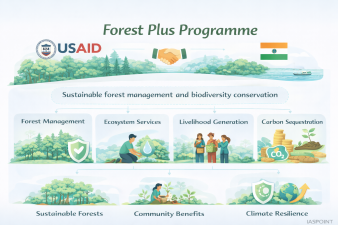
Forest-PLUS (Partnership for Land Use Science) is a bilateral initiative between the Ministry of Environment, Forest and Climate Change (MoEFCC), India, and the United States Agency for International Development (USAID). Launched to accelerate India’s transition to a low-carbon economy, the program focuses on enhancing forest landscape management to boost ecosystem services and address climate change through carbon sequestration.
Evolution: Forest-PLUS 1.0 vs. Forest-PLUS 2.0
The initiative has transitioned through two distinct phases, evolving from technical capacity building to landscape-level implementation.
| Feature | Forest-PLUS 1.0 (2012–2017) | Forest-PLUS 2.0 (2018–2023) |
| Primary Goal | Capacity building for REDD+ implementation. | Improving forest management for Water and Prosperity. |
| Key Output | Tools for carbon monitoring and forest inventory. | Decision Support Systems (DSS) and market-based instruments. |
| Landscapes | Karnataka, MP, Himachal Pradesh, Sikkim. | Gaya (Bihar), Medak (Telangana), Thiruvananthapuram (Kerala). |
| Core Focus | Scientific and technical collaboration. | Ecosystem services (water) and inclusive economic growth. |
Core Objectives of Forest-PLUS 2.0
Forest-PLUS 2.0, subtitled “Forests for Water and Prosperity,” aims to provide technical assistance to manage forests as vital components of inclusive economic growth.
- Ecosystem-Based Management: Strengthening the management of forest landscapes by using a holistic ecosystem approach rather than just focusing on timber.
- Valuation of Ecosystem Services: Factoring in the economic value of services like water filtration and carbon storage into forest management plans.
- Inclusive Economic Opportunities: Creating sustainable livelihood opportunities for forest-dependent communities, specifically targeting women and marginalized groups.
- Private Sector Engagement: Demonstrating market-based mechanisms where industries or municipalities pay upstream communities for protecting forested watersheds.
Key Innovations and Tools
The program has introduced several high-tech and systemic tools to modernize Indian forestry.
- Van 3.0: An integrated mobile app and web portal system for collecting forest inventory and ecosystem data. It automates data analysis for the preparation of Forest Working Plans.
- Decision Support Systems (DSS): Software tools designed to help forest managers evaluate the impact of different management interventions on ecosystem services.
- Incentive-Based Mechanisms (IBM): Pilot models where conservation efforts are rewarded through financial or market-linked benefits.
- Low-Carbon Technology: Promotion of bio-briquettes and solar heating systems to reduce the dependency of local communities on forest fuelwood.
Significant Pilot Sites and Outcomes
The choice of sites for Forest-PLUS 2.0 reflects diverse ecological challenges across the Indian landscape.
- Gaya (Bihar): Focuses on restoring forest-deficit areas and managing degraded landscapes.
- Medak (Telangana): Concentrates on community-led management in semi-arid regions to enhance water availability and livelihoods.
- Thiruvananthapuram (Kerala): Works within the Agasthyamala Biosphere Reserve to help the Kani Tribe sustainably harvest and market non-timber forest products (NTFPs) like wild honey and black dammar resin.
Strategic Relevance for UPSC
- International Commitments: The program helps India achieve its Nationally Determined Contribution (NDC) target under the Paris Agreement to create an additional carbon sink of 2.5 to 3 billion tonnes of CO2 equivalent by 2030.
- REDD+ Linkage: It directly supports the Reducing Emissions from Deforestation and Forest Degradation (REDD+) mechanism under the UNFCCC by creating financial value for carbon stored in forests.
- Institutional Alignment: It complements the National Mission for a Green India (GIM), one of the eight missions under the National Action Plan on Climate Change (NAPCC).