
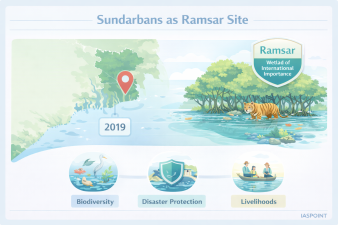
The Sundarbans Wetland, located in West Bengal, is the largest Ramsar site in India and forms part of the world’s largest mangrove forest. It was designated as a Wetland of International Importance on February 1, 2019, due to its unique ecosystem that serves as a vital bridge between terrestrial and marine environments.
Geographical and Ecological Profile
The Sundarbans is a massive deltaic complex formed by the confluence of the Ganges, Brahmaputra, and Meghna rivers.
- Transboundary Nature: Approximately 40% of the Sundarbans lies in India (West Bengal), while 60% is in Bangladesh. Both sections are designated as Ramsar sites.
- Unique Vegetation: It is dominated by Halophytes (salt-tolerant plants). The name “Sundarbans” is derived from the Sundari tree (Heritiera fomes), which is famous for its durable timber.
- Pneumatophores: To survive in anaerobic, waterlogged soil, the mangroves possess “blind roots” or spikes that grow upwards to breathe oxygen from the air.
Biodiversity and Iconic Species
The Sundarbans is a biodiversity hotspot and a critical habitat for several globally threatened species.
| Species Category | Key Examples |
|---|---|
| Flagship Species | Royal Bengal Tiger (The only tiger population in the world living in a mangrove habitat). |
| Aquatic Mammals | Irrawaddy Dolphin and Ganges River Dolphin. |
| Reptiles | Estuarine Crocodile (Saltwater Crocodile) and the Northern River Terrapin (Batagur baska). |
| Avifauna | Masked Finfoot and various species of Kingfishers. |
| Marine Life | Olive Ridley Turtles (nesting sites) and Horseshoe Crabs. |
Conservation Status and Designations
The Sundarbans is unique because it holds multiple international and national protection statuses simultaneously:
- Ramsar Site (2019): Designated for its global importance in waterbird support and coastal protection.
- UNESCO World Heritage Site (1987): Recognized for its outstanding universal value and biological diversity.
- Biosphere Reserve (1989): Part of the UNESCO Man and the Biosphere (MAB) Programme.
- Tiger Reserve: It is a critical tiger habitat protected under Project Tiger.
Ecosystem Services and “Wise Use”
The Sundarbans acts as a natural safeguard for the eastern coast of India.
- Bio-Shield: It functions as a “Natural Cyclone Barrier,” dissipating the energy of tidal surges and severe cyclonic storms (e.g., Cyclone Amphan, Remal) before they reach inland areas like Kolkata.
- Carbon Sequestration: It is a massive Blue Carbon sink, storing significantly more carbon per hectare than tropical upland forests.
- Livelihood Support: Provides sustenance to millions through “Wise Use” of non-timber forest products (NTFP) such as honey (Moulir community) and sustainable artisanal fishing.
Major Threats and Challenges
The Sundarbans faces severe ecological pressure due to climate change and human interference.
- Sea Level Rise: The Sundarbans is experiencing a rate of sea-level rise higher than the global average, leading to island submergence (e.g., Lohachara and Ghoramara islands).
- Increased Salinity: Reduced freshwater flow from the upstream Ganges (due to dams and diversions) is increasing salinity, which stunts the growth of Sundari trees.
- Human-Wildlife Conflict: High population density on the fringes leads to frequent tiger-human encounters.
- Plastic Pollution: Recent studies (2025-2026) have highlighted the increasing threat of microplastics entering the food chain through the estuarine waters.
Facts for Prelims Trivia
- UNESCO Double Entry: The Indian Sundarbans and the Bangladesh Sundarbans are listed as separate UNESCO World Heritage sites but form a contiguous ecological unit.
- Keibul Lamjao Comparison: While Loktak has floating islands (Phumdis), the Sundarbans is known for its mudflats that are exposed during low tide and submerged during high tide.
- First Ramsar Site? No. Chilika Lake and Keoladeo National Park were the first (1981). Sundarbans joined much later in 2019.