
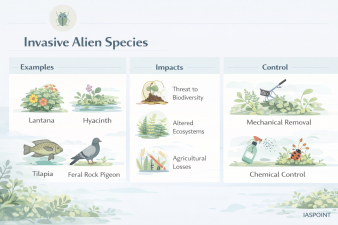
Invasive Alien Species (IAS) are plants, animals, or microorganisms that are introduced—intentionally or unintentionally—to an environment outside their natural habitat, where they establish themselves, outcompete native species, and take over the new environment.
- Impact on Biodiversity: They are the second most significant cause of biodiversity loss globally after habitat destruction.
- Biological Traits: High reproductive rate, rapid growth, phenotypic plasticity (ability to adapt to various environments), and lack of natural predators in the new habitat.
- Economic Cost: According to the IPBES 2023 report, IAS cost the global economy over $423 billion annually.
Major Invasive Plant Species in India
The Botanical Survey of India (BSI) and the Ministry of Environment, Forest and Climate Change (MoEFCC) have identified several aggressive plant invaders that threaten Indian ecosystems.
| Common Name | Scientific Name | Origin | Impact/Trivia |
|---|---|---|---|
| Water Hyacinth | Eichhornia crassipes | South America | Known as the “Terror of Bengal”. Blocks sunlight, depletes oxygen (BOD increases), and chokes water bodies. |
| Lantana | Lantana camara | Tropical America | Covers nearly 40% of India’s tiger range. It is allelopathic (releases chemicals that inhibit other plants). |
| Parthenium | Parthenium hysterophorus | Mexico/USA | Also called “Congress Grass” or “Gajar Ghas”. Causes respiratory issues (asthma) and skin allergies in humans. |
| Prosopis Juliflora | Prosopis juliflora | Mexico/S. America | Known as “Vilayati Kikar”. Highly invasive in the Delhi Ridge and Southern India; lowers the water table. |
| Siam Weed | Chromolaena odorata | Central America | Rapidly invades forest clearings and plantations in the Western Ghats and NE India. |
| Mikania | Mikania micrantha | South America | Known as the “Mile-a-minute weed”. A climbing vine that smothers tropical forests. |
Specific Regional Threats
IAS affects different Indian biomes uniquely, requiring specific management strategies.
Marine and Coastal Invasives
- Kappaphycus alvarezii: An exotic seaweed introduced for commercial cultivation in the Gulf of Mannar. It has spread to coral reefs, smothering and killing them.
- Charru Mussel (Mytella strigata): An invasive mussel from South America currently devastating the backwaters of Kerala and replacing native green and brown mussels.
Forest and Grassland Invasives
- Senna spectabilis: An exotic tree species rapidly invading the Wayanad Wildlife Sanctuary and other parts of the Nilgiri Biosphere Reserve, displacing native fodder for elephants and gaur.
- Prosopis juliflora in Banni Grasslands: This species has significantly altered the ecology of the Banni grasslands in Kutch, Gujarat, affecting the livelihoods of the Maldhari community.
International and National Frameworks
Global and domestic efforts are aligned to mitigate the spread of IAS under various conventions.
Convention on Biological Diversity (CBD)
- Aichi Target 9: Aimed at identifying and prioritizing invasive species and their pathways by 2020.
- Kunming-Montreal Global Biodiversity Framework (2022): Target 6 specifically aims to reduce the rate of introduction and establishment of invasive alien species by at least 50% by 2030.
IPBES Assessment Report on IAS (2023)
- The Intergovernmental Science-Policy Platform on Biodiversity and Ecosystem Services (IPBES) noted that more than 37,000 alien species have been established worldwide.
- It highlights that IAS are a key driver in 60% of global plant and animal extinctions.
National Initiatives in India
- Plant Quarantine (Regulation of Import into India) Order, 2003: Regulates the entry of exotic plant materials.
- Wildlife Protection Act (Amendment) 2022: Empowered the Central Government to regulate or prohibit the import, trade, and possession of invasive alien species.
- Management Protocols: The National Biodiversity Authority (NBA) works with state boards to map and eradicate species like Lantana through the “Cut Root Stock” method.
Important Facts for Prelims
- Allelopathy: The chemical inhibition of one plant by another. Most IAS (like Lantana and Parthenium) use this to dominate landscapes.
- Island Vulnerability: Island ecosystems (Andaman & Nicobar) are significantly more vulnerable to IAS because native species evolved in isolation and lack defense mechanisms.
- Papaya Mealybug: A significant invasive insect pest in India that caused massive losses to papaya, mulberry, and cassava crops until biological control (wasps) was introduced.
- The “Yellow Crazy Ant”: An invasive ant species in the Vellore region of Tamil Nadu that has been known to blind livestock and affect local biodiversity.