
Coral reefs, often termed “Rainforests of the Sea,” are massive limestone structures created by tiny living polyps in a symbiotic relationship with Zooxanthellae (microscopic algae). In India, coral reefs are predominantly found in shallow, clear tropical waters.
- Total Area: Approximately 2,375 sq. km.
- Geographical Distribution: Found primarily in four major regions:
- Andaman and Nicobar Islands: Largest coral reef area in India; mostly Fringing reefs.
- Lakshadweep Islands: The only Atoll reefs in India.
- Gulf of Mannar: Rich biodiversity; Fringing reefs.
- Gulf of Kutch: Extreme northern limit; dominated by Fringing reefs with high sediment tolerance.
- Minor Areas: Patchy corals are also found along the Konkan coast (Malvan), Netrani Island (Karnataka), and Angria Bank (Maharashtra).
Major Types of Coral Reefs
India hosts three of the four main types of coral formations:
| Type | Description | Indian Example |
| Fringing Reefs | Grow near the coastline around islands and continents. | Andaman & Nicobar, Gulf of Mannar |
| Atoll Reefs | Circular or horse-shoe shaped reefs surrounding a central lagoon. | Lakshadweep Islands |
| Platform/Patch Reefs | Isolated, flat-topped reefs that grow on the continental shelf. | Palk Bay, Gulf of Kutch |
Legal and Institutional Protection
Corals enjoy the highest level of legal protection in India to prevent exploitation and habitat destruction.
- Wildlife (Protection) Act, 1972: All scleractinian (stony) corals are listed under Schedule I, granting them the same protection as the Royal Bengal Tiger.
- CRZ Notification (2019): Coral areas are classified as CRZ-IA (Ecologically Sensitive Areas), where no developmental activity is permitted.
- National Coastal Mission: Oversees the conservation and monitoring of coral health through the Ministry of Environment, Forest and Climate Change (MoEFCC).
Key Conservation Techniques and Initiatives
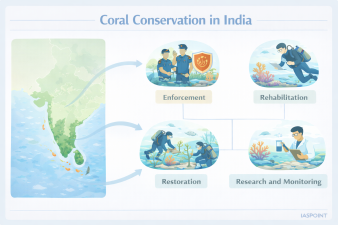
India has moved toward active restoration to combat the effects of climate change and coral bleaching.
Biorock Technology (Mineral Accretion Technology)
- Mechanism: Small amounts of electricity are passed through underwater metal frames, causing calcium carbonate to precipitate and form “artificial reefs.”
- Benefit: Corals grown on Biorock structures are found to be 20 times more resilient to bleaching and have a faster growth rate.
- Implementation: First pioneered in the Gulf of Kutch (Zonal Anthropogenic Pressure) by the Zoological Survey of India (ZSI).
Coral Transplantation
- Healthy coral fragments (nurseries) are manually attached to concrete frames or natural substrates in degraded areas. This has been successfully executed in the Gulf of Mannar and Lakshadweep.
Global Alliances
- International Coral Reef Initiative (ICRI): India is a member of this informal partnership that strives to preserve coral reefs and related ecosystems globally.
- G20 Coral Research & Development Accelerator Platform (CORDAP): India actively participates in this global effort to fast-track research for coral survival.
Threats to Indian Corals
- Coral Bleaching: Triggered by rising Sea Surface Temperatures (SST). When water is too warm, corals expel zooxanthellae, turning white and eventually dying if the stress persists.
- Ocean Acidification: Increased CO2 absorption by oceans reduces the availability of carbonate ions, making it harder for corals to build their skeletons.
- Anthropogenic Pressure: Destructive fishing (cyanide/dynamite), siltation from coastal construction, and plastic pollution.
- Invasive Species: Outbreaks of the Crown-of-Thorns Starfish (Acanthaster planci) which prey on coral polyps.
Facts for Prelims Trivia
- Gulf of Kutch corals: These are unique because they have adapted to survive in areas with high salinity and significant temperature fluctuations.
- Zooxanthellae Symbiosis: The coral provides the algae with a protected environment and compounds for photosynthesis; the algae provide the coral with oxygen and organic products (glucose, glycerol).
- Angria Bank: A submerged plateau off the coast of Maharashtra, recently identified as a high-biodiversity “Great Barrier Reef” of the West Coast.
- Coral Bleaching Alert System (CBAS): Operated by INCOIS (Hyderabad), it provides satellite-based updates on potential bleaching events based on Degree Heating Weeks (DHW).