
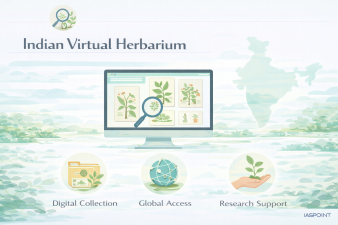
The Indian Virtual Herbarium (IVH) is a comprehensive digital database of plants and preserved plant specimens found in India. Launched by the Botanical Survey of India (BSI) under the Ministry of Environment, Forest and Climate Change (MoEFCC), it represents the largest database of plant specimens in Southeast Asia. For UPSC aspirants, it is a key development in the digitization of biological resources and the implementation of the Biological Diversity Act, 2002.
Core Objectives and Significance
- Digital Documentation: To provide a centralized open-access platform for the digitized images and metadata of herbarium specimens.
- Research Accessibility: Enables scientists, taxonomists, and students globally to access India’s floral wealth without physically visiting multiple herbaria.
- Conservation Monitoring: Helps in identifying the historical distribution of species, aiding in the assessment of climate change impacts on plant habitats.
- IPR Protection: Serves as a digital record to prevent “wrongful” patents on Indian plant species by providing evidence of “prior art.”
Institutional Framework
- Developed by: The Botanical Survey of India (BSI), which is headquartered in Kolkata.
- Technology: The portal was developed with the assistance of the National Informatics Centre (NIC).
- Scope: It integrates data from various regional circles of the BSI and other major herbaria across the country.
Key Features and Data Categories
The IVH provides detailed information categorized for ease of scientific navigation.
| Category | Description |
| Type Specimens | Original specimens used for the first scientific description and naming of a plant species. These are the “gold standards” in taxonomy. |
| Wallich Herbarium | Contains specimens collected by Nathaniel Wallich, a pioneer in Indian botany; includes several historical collections. |
| Metadata | Each entry includes scientific name, family, locality of collection, collector name, and date of collection. |
| QR Coding: | Each digitized specimen is assigned a unique QR code for easy tracking and identification. |
Floral Wealth of India: Key Statistics
The IVH highlights the massive scale of India’s biodiversity, which is essential for “Environment and Ecology” prelims questions.
- Total Specimen Records: Over 1,00,000 (1 lakh) specimens have been digitized, with a target to include all 3 million specimens held by BSI.
- Endemic Species: The database specifically tracks plants unique to the Western Ghats, Himalayas, and Andaman & Nicobar Islands.
- Threatened Species: Includes digital records of species listed under the IUCN Red List (Extinct in the Wild, Critically Endangered, etc.).
The Process of Herbarium Preparation
For context, a physical herbarium (which the IVH digitizes) involves:
- Field Collection: Gathering plant samples with flowers/fruits.
- Pressing: Flattening the plant between sheets of paper to remove moisture.
- Drying: Ensuring no fungal growth occurs.
- Mounting: Attaching the specimen to a standard herbarium sheet (29 × 41.5 cm).
- Labeling: Recording the “passport data” (who, when, where).
Comparison: Physical vs. Virtual Herbarium
| Feature | Physical Herbarium | Virtual Herbarium (IVH) |
| Accessibility | Restricted to physical location | Global, 24/7 access |
| Preservation | Susceptible to pests/decay | Permanent digital record |
| Searchability | Manual/Time-consuming | Instant (Keyword, Family, Region) |
| Utility | Required for DNA/Microscopy | Ideal for Morphology/Mapping |
Trivia for Prelims
- Central National Herbarium (CNH): Located at the Acharya Jagadish Chandra Bose Indian Botanic Garden in Howrah, it is the largest herbarium in India and the primary source for IVH data.
- Kolkata Connection: The BSI was established in 1890 under the direction of Sir George King, making it one of the oldest botanical institutions globally.
- Plant Discoveries: BSI publishes the annual “Plant Discoveries” report; the IVH is updated continuously as new species are identified.