
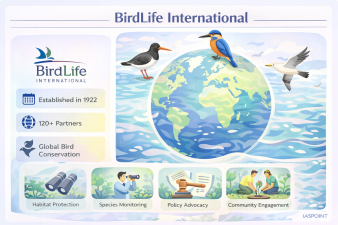
BirdLife International is a global partnership of non-governmental conservation organizations that strives to conserve birds, their habitats, and global biodiversity. It is widely recognized as the world’s largest nature conservation partnership.
- Status: Global Partnership (NGO).
- Headquarters: Cambridge, United Kingdom.
- Red List Authority: It is the official Red List Authority for birds for the IUCN Red List of Threatened Species. It assesses the conservation status of all the world’s 11,000+ bird species.
- Core Philosophy: Birds are “environmental indicators”; their status reflects the overall health of ecosystems.
Important Bird and Biodiversity Areas (IBAs)
The IBA program is BirdLife International’s flagship initiative. IBAs are sites of international importance for bird conservation, identified based on standardized, internationally agreed criteria.
Selection Criteria for IBAs
To be categorized as an IBA, a site must meet at least one of the following:
- A1 (Globally Threatened Species): The site holds a significant population of a species categorized by the IUCN Red List as Critically Endangered, Endangered, or Vulnerable.
- A2 (Restricted-range Species): The site is one of a set selected to ensure all species of a restricted range (Endemic Bird Areas) are represented.
- A3 (Biome-restricted Species): The site holds a significant component of the group of species whose distributions are restricted to a particular biome.
- A4 (Congregations): The site holds exceptionally large numbers of birds (e.g., 1% of a global or flyway population) for breeding, wintering, or during migration.
BirdLife International in India: The BNHS Partnership
The Bombay Natural History Society (BNHS) is the exclusive Indian partner of BirdLife International. Together, they manage the “Indian Bird Conservation Network” (IBCN).
| Metric | Details |
|---|---|
| Total IBAs in India | 554 sites (as per the second edition of the IBA book). |
| Notable IBAs | Keoladeo National Park (Rajasthan), Vedanthangal (TN), Thane Creek (Maharashtra). |
| Key Publications | Important Bird and Biodiversity Areas in India: Priority Sites for Conservation. |
| Current Focus (2026) | Implementation of the Central Asian Flyway (CAF) initiative and wetland restoration. |
Major Global Initiatives and Programs
- Flyways Program: Focuses on the conservation of migratory birds across the world’s eight major flyways, including the Central Asian Flyway which covers India.
- Marine Program: Aims to reduce seabird bycatch in fisheries and identify Marine Important Bird Areas (mIBAs).
- Preventing Extinctions Program: Acts as a catalyst for conservation action for the world’s most threatened birds (e.g., California Condor, Philippine Eagle).
- Forests of Hope: A network of sites focused on large-scale forest restoration and sustainable management.
2026 Strategic Focus and Current Developments
- Target 6 Integration: Actively working towards the Kunming-Montreal Global Biodiversity Framework, specifically focusing on reducing the rate of invasive species introduction by 50% by 2030.
- CAF Workshop (March 2026): BNHS and BirdLife International recently concluded a high-level capacity-building workshop in New Delhi involving 13 countries to strengthen the Central Asian Flyway conservation network.
- Nature-Safe Energy: Promoting guidelines for wind and solar infrastructure to prevent avian collisions and habitat displacement.
Key Trivia for Prelims
- Misconception Alert: BirdLife International did not originate the concept of “Biodiversity Hotspots”; that was developed by British ecologist Norman Myers in 1988.
- Possibly Extinct (PE) Tag: BirdLife International pioneered the “Possibly Extinct” tag for the IUCN Red List to handle Critically Endangered species that have not been seen in the wild for years but lack definitive proof of extinction.
- State of the World’s Birds: This is their definitive report (published every four years) summarizing the health of global avian populations.
- Global Name Change: In 2014, “Important Bird Areas” was renamed to “Important Bird and Biodiversity Areas” to reflect the broader ecological significance of these sites.