

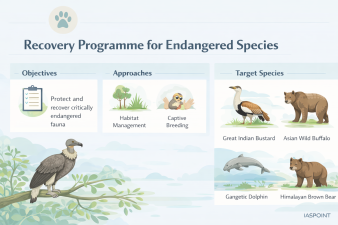
The Recovery Programme for Endangered Species is one of the three major components of the centrally sponsored scheme Integrated Development of Wildlife Habitats (IDWH). Launched by the Ministry of Environment, Forest and Climate Change (MoEFCC), it provides financial and technical assistance to State/UT governments for the protection and conservation of nearly extinct wildlife species and their habitats.
Components of the Integrated Development of Wildlife Habitats (IDWH)
To understand the Recovery Programme, it is essential to see its position within the broader IDWH framework:
- Support to Protected Areas: National Parks, Wildlife Sanctuaries, Conservation Reserves, and Community Reserves.
- Protection of Wildlife Outside Protected Areas: Conserving wildlife in areas not formally designated as “Protected.”
- Recovery Programme for Endangered Species: Focused intervention for a specific list of critically endangered species.
List of Species Under the Recovery Programme
Initially, the programme started with a small list, but it has expanded over the years. As of early 2026, there are 22 species identified under this programme.
| Category | Species Included |
| Terrestrial Mammals | Snow Leopard, Red Panda, Asiatic Lion, One-horned Rhinoceros, Nilgiri Tahr, Hangul, Himalayan Brown Bear, Malabar Civet |
| Marine Mammals | Dugong (Sea Cow), Gangetic River Dolphin |
| Birds | Great Indian Bustard, Bengal Florican, Lesser Florican, Jerdon’s Courser, Nicobar Megapode, Vultures |
| Marine/Aquatic | Marine Turtles (Olive Ridley, etc.), Gharial |
| Others | Manipur Brow-antlered Deer (Sangai), Wild Buffalo, Swamp Deer (Barasingha), Northern River Terrapin, Arabian Sea Humpback Whale |
Selection Criteria and Strategy
Species are selected based on their precarious population levels and their ecological importance.
- Critically Endangered Status: Preference is given to species listed as “Critically Endangered” by the IUCN or placed in Schedule I of the Wildlife Protection Act, 1972.
- Habitat Restoration: The programme doesn’t just focus on the animal but also on restoring the specific ecosystem it depends on (e.g., grasslands for the Great Indian Bustard).
- Scientific Monitoring: Use of advanced technology like camera traps, GPS collars, and DNA profiling to monitor individuals.
- Ex-situ Conservation: Building Conservation Breeding Centres to increase numbers before releasing animals back into the wild.
Key Species Interventions and Successes
- Snow Leopard: Conservation through the “Project Snow Leopard” across five Himalayan states, focusing on high-altitude ecosystem health and community-led “Snow Leopard Conservancies.”
- Great Indian Bustard (GIB): Intensive habitat management in Rajasthan (Desert National Park) and Gujarat. It involves the “Firefly Bird Diverters” to prevent collision with power lines.
- Dugong: Conservation efforts in the Gulf of Mannar, Palk Bay, and Andaman and Nicobar Islands, focusing on seagrass meadow restoration.
- Hangul (Kashmir Stag): Protecting the last viable population in Dachigam National Park, Jammu & Kashmir.
Administrative and Funding Pattern
The programme is a Centrally Sponsored Scheme (CSS), meaning the cost is shared between the Union and the States.
| Region | Central Share | State Share |
| General Category States | 60% | 40% |
| Northeast & Himalayan States | 90% | 10% |
| Union Territories | 100% | 0% |
Institutional Framework
- National Board for Wildlife (NBWL): The apex body chaired by the Prime Minister that approves major policy changes.
- Wildlife Institute of India (WII): Provides the technical and scientific expertise for population estimation and recovery protocols.
- State Wildlife Boards: Chaired by the respective Chief Ministers to oversee implementation at the ground level.
Trivia for UPSC Prelims
- Latest Additions: The Arabian Sea Humpback Whale and the Caracal (a medium-sized wild cat) were among the more recent additions to the recovery list.
- Success Story: The Asiatic Lion recovery in Gir is often cited as a benchmark, leading to discussions about translocation to Kuno National Park to ensure a second home.
- The “Extinct” Status: The programme also monitors species that might have gone extinct locally to explore reintroduction possibilities, similar to the Cheetah reintroduction in Kuno (though the Cheetah was brought from Africa, it falls under a similar conservation philosophy).
- Schedule I Importance: Almost all species under this recovery programme enjoy the highest level of protection under the Wildlife (Protection) Act, 1972.