

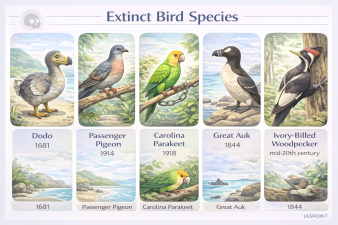
Avian extinction refers to the complete disappearance of a bird species from the wild and captivity. According to the IUCN Red List, a species is declared Extinct (EX) when there is no reasonable doubt that the last individual has died after exhaustive surveys. In the 21st century, extinction rates have accelerated due to habitat loss, invasive species, and climate change.
Global Extinct Bird Species (Modern Era)
The 20th and 21st centuries have seen the loss of several iconic and evolutionarily unique bird species. The extinction of the Kauaʻi ʻōʻō in 1987, for instance, marked the extinction of an entire avian family (Mohoidae).
| Species | Extinction/Last Sighted | Location | Primary Cause |
|---|---|---|---|
| Dodo (Raphus cucullatus) | ~1662 | Mauritius | Invasive species & hunting |
| Passenger Pigeon | 1914 | North America | Massive overhunting |
| Great Auk | 1844 | North Atlantic | Hunting for feathers/meat |
| Bachman’s Warbler | 1962 (Declared EX 2023) | USA/Cuba | Habitat loss (swamps) |
| Poʻouli | 2004 | Hawaii, USA | Avian malaria (mosquitoes) |
| Spix’s Macaw | 2000 (Extinct in Wild) | Brazil | Illegal pet trade & habitat loss |
The “Possibly Extinct” Category in India
In the Indian context, several species have not been reliably sighted for decades. While the IUCN may still categorize some as Critically Endangered (CR), they are often considered “possibly extinct” by ornithologists in the field.
Himalayan Quail (Ophrysia superciliosa)
- Last Sighted: 1876 in the western Himalayas (Mussoorie/Nainital).
- Status: Critically Endangered (Possibly Extinct).
- Fact: It is a medium-sized bird with a red bill and legs, preferring long grass and brush on steep hillsides.
Pink-headed Duck (Rhodonessa caryophyllacea)
- Last Sighted: 1935 (unconfirmed sightings in Myanmar recently).
- Status: Critically Endangered (Possibly Extinct).
- Fact: Historically found in the Gangetic plains and parts of Myanmar; it was known for its distinctive pink head and neck.
Siberian Crane (Grus leucogeranus)
- Last Sighted in India: 2002 at Keoladeo National Park (Bharatpur).
- Status: Critically Endangered.
- Fact: The Central Asian flock that wintered in India is now considered extinct in the wild, though the Eastern flock still migrates from Siberia to China.
Critically Endangered Birds (On the Brink)
For UPSC Prelims, it is vital to distinguish between species that are truly extinct and those that are “functionally extinct” or Critically Endangered.
- Great Indian Bustard (GIB): Fewer than 150 remain; primary threat is high-voltage power lines in Rajasthan and Gujarat.
- Forest Owlet: Thought to be extinct for 113 years until its rediscovery in 1997 in Maharashtra/MP.
- Jerdon’s Courser: Rediscovered in 1986 in Andhra Pradesh; extremely rare nocturnal bird.
- Vulture Species: White-backed, Slender-billed, and Long-billed vultures faced a 99% decline due to Diclofenac poisoning.
Drivers of Avian Extinction
- Invasive Species: Rats, cats, and mosquitoes (carrying avian malaria) have devastated island bird populations (e.g., Hawaii and Guam).
- Anthropogenic Pressure: Conversion of grasslands (Bengal Florican) and wetlands (Baer’s Pochard) for agriculture.
- Infrastructure: Collision with wind turbines and power lines is the leading modern threat to large flyers like the GIB.
- Chemical Poisoning: Use of pesticides and NSAIDs (Diclofenac) in livestock.
UPSC Prelims: Essential Trivia
- The Lazaurs Effect: Refers to species that disappear from the fossil record or sightings only to “reappear” later (e.g., Forest Owlet).
- Endemic Birds of India: A 2023 ZSI report highlights that 5% of India’s birds (78 species) are endemic, with the highest concentration in the Andaman and Nicobar Islands.
- IUCN Green Status: A new metric introduced to measure the success of conservation recovery, complementing the Red List’s focus on extinction risk.