
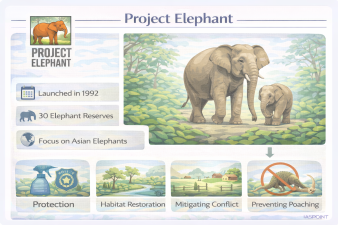
Launched in 1992 by the Ministry of Environment and Forests (now MoEFCC), Project Elephant is a Centrally Sponsored Scheme (CSS) designed to provide financial and technical support to wildlife management efforts by states for their free-ranging populations of wild Asian Elephants (Elephas maximus). India holds approximately 60% of the world’s Asian elephant population, making the success of this project vital for the species’ global survival.
Primary Objectives and Pillars of Implementation
Project Elephant operates on a multi-pronged strategy to ensure the long-term viability of elephant populations in their natural habitats.
- Ecological Integrity: Protecting elephants, their natural habitats, and traditional migratory corridors.
- Conflict Mitigation: Developing strategies to reduce Human-Elephant Conflict (HEC) through physical barriers, compensation, and community awareness.
- Welfare of Captive Elephants: Ensuring the health and ethical treatment of domesticated elephants used in temples, tourism, or forest departments.
- Anti-Poaching Measures: Strengthening protection against illegal ivory trade and retaliatory killings.
Classification and Legal Protection Status
The Asian Elephant is granted the highest level of protection under various national and international frameworks.
| Framework | Status/Category |
| Wildlife Protection Act, 1972 | Schedule I (Highest Protection) |
| IUCN Red List | Endangered |
| CITES | Appendix I |
| CMS (Bonn Convention) | Appendix I |
Elephant Reserves and Distribution in India
As of current records, there are 33 notified Elephant Reserves (ERs) in India, covering over 80,000 square kilometers. The Terai Elephant Reserve (TER) in Uttar Pradesh and Agasthyamalai Elephant Reserve in Tamil Nadu are among the most recent additions.
Regional Distribution Patterns
- South India: Houses the largest population, primarily in the Nilgiri Biosphere Reserve (Karnataka, Kerala, Tamil Nadu).
- North-East India: Significant populations in Assam (Kaziranga-Karbi Anglong) and Arunachal Pradesh.
- East-Central India: Includes states like Odisha, Jharkhand, and Chhattisgarh, which face high rates of HEC.
- North India: Primarily restricted to the Shivalik ranges in Uttarakhand and Uttar Pradesh.
Monitoring and Technical Initiatives
The MoEFCC employs several scientific methods to monitor and protect elephant populations across the country.
Monitoring of Illegal Killing of Elephants (MIKE)
MIKE is an international program established by CITES to track trends in elephant poaching. In India, several sites are designated as MIKE sites, including Chirang-Ripu (Assam), Deomali (Arunachal Pradesh), Garo Hills (Meghalaya), Nilgiri (Karnataka), and Wayanad (Kerala).
Elephant Census and Counting Methods
The national elephant census is typically conducted every five years. The Elephant Census 2017 reported a total of 29,964 elephants. Modern methodologies have shifted toward DNA profiling and camera trapping to supplement the traditional “dung decay” and direct sighting methods for more accurate density estimates.
Human-Elephant Conflict (HEC) Management
Human-Elephant Conflict is the most significant challenge to the project, resulting in hundreds of human and elephant deaths annually due to crop raiding and habitat fragmentation.
- Gaja Kotha Campaign: An awareness initiative in Assam to foster coexistence.
- Project RE-HAB: Reducing Elephant-Human Attacks using Bees. This initiative by the Khadi and Village Industries Commission (KVIC) uses honeybee boxes as fences to deter elephants.
- Eco-Bridges: Specialized overpasses or underpasses constructed at railway tracks and highways to facilitate safe passage.
- Compensation Schemes: Standardized ex-gratia payments for loss of life, injury, or crop damage to prevent retaliatory poisoning or electrocution.
Key Facts and Trivia for UPSC Prelims
- National Heritage Animal: The Government of India declared the Elephant as the National Heritage Animal in 2010 based on the recommendations of the Elephant Task Force (Mahesh Rangarajan Committee).
- Matriarchal Society: Elephant herds are led by the oldest female (Matriarch); adult males are usually solitary or form temporary “bachelor” groups.
- Gestation Period: Elephants have the longest gestation period of any mammal, lasting approximately 22 months.
- Keystone Species: Elephants are “Engineers of the Forest,” creating clearings and dispersing seeds that maintain forest diversity.
- Haathi Mere Saathi: A campaign launched by MoEFCC in collaboration with Wildlife Trust of India (WTI) to improve public awareness and conservation sentiment.
Major Elephant Corridors
Corridors are narrow strips of land that allow elephants to move between two larger habitats. There are approximately 100+ identified corridors in India. The “Right of Passage” report by Wildlife Trust of India identifies these areas as critical for preventing genetic isolation. Securing these corridors often involves voluntary relocation of forest-dwelling communities or land acquisition by the state.
Last Modified: April 18, 2026