

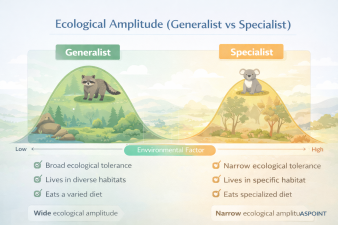
Ecological amplitude refers to the range of environmental conditions (the gradient) within which a specific species can survive and flourish. It is the quantitative expression of a species’ tolerance. A wide ecological amplitude indicates that a species can inhabit diverse environments, while a narrow amplitude suggests a species is restricted to very specific conditions.
Ecological Generalists: Wide Amplitude
Generalist species are organisms that can thrive in a wide variety of environmental conditions and can make use of a variety of different resources. They possess a broad niche.
- Dietary Flexibility: Generalists typically have an omnivorous diet or can switch food sources based on availability.
- Habitat Versatility: They are often found across multiple latitudinal or altitudinal zones.
- Resilience: These species are generally more resilient to environmental changes, such as urban sprawl or climate fluctuations.
- Examples:
- Raccoons: Inhabit forests, mountains, and large cities; eat fruits, insects, and human trash.
- Common Crow: Found across diverse climates and urban-rural gradients in India.
- Coyotes: Adapted to both desert heat and suburban environments.
Ecological Specialists: Narrow Amplitude
Specialist species can only thrive in a narrow range of environmental conditions or have a very limited diet. They possess a narrow niche.
- Resource Dependence: Many specialists rely on a single food source or a specific nesting site.
- Sensitivity: They are highly susceptible to extinction if their specific habitat is disturbed or if their primary food source disappears.
- Competitive Advantage: Within their specific niche, specialists are often more efficient than generalists at exploiting resources.
- Examples:
- Giant Panda: Diet is composed almost exclusively of bamboo (99%).
- Koala: Feeds specifically on certain types of Eucalyptus leaves.
- Orchids: Many species require specific fungal associations and precise humidity levels to germinate.
Comparison: Generalists vs. Specialists
| Feature | Generalist Species | Specialist Species |
| Niche Breadth | Broad | Narrow |
| Diet | Varied (euryphagous) | Specific (stenophagous) |
| Tolerance Range | Wide (Eurytopic) | Narrow (Stenotopic) |
| Adaptability | High; thrives in changing habitats | Low; suffers in changing habitats |
| Risk of Extinction | Generally Lower | Generally Higher |
| Population Growth | Often rapid (r-selected traits) | Often stable (K-selected traits) |
Niche Overlap and Competition
When the ecological amplitudes of two species overlap, they compete for the same resources.
- Niche Partitioning: To avoid competitive exclusion (Gause’s Law), species often evolve to use different parts of the resource or hunt at different times.
- Broad vs. Narrow: In a stable environment, specialists often out-compete generalists because they are finely tuned to the local conditions. However, in a rapidly changing environment (like the current Anthropocene), generalists usually gain the upper hand.
UPSC Prelims Specific Trivia and Facts
- Invasive Species: Most successful invasive species (e.g., Lantana camara, Water Hyacinth) are generalists with wide ecological amplitudes, allowing them to colonize new regions easily.
- Endemic Species: Most endemic species (found only in one specific geographic area, like the Lion-tailed Macaque in the Western Ghats) are specialists. Their narrow amplitude makes them high-priority targets for conservation under the IUCN Red List.
- Ecological Valency: This is a synonymous term for ecological amplitude, representing the degree to which a species can withstand variations in its environment.
- The Specialist Paradox: While being a specialist is risky during environmental shifts, it reduces inter-specific competition in resource-rich, stable environments like tropical rainforests.