
Coral reef restoration refers to active human interventions aimed at assisting the recovery of degraded, damaged, or destroyed coral ecosystems. Given the increasing frequency of global mass bleaching events—with the Fourth Global Bleaching Event (2023–2026) impacting over 80% of the world’s reefs—restoration has shifted from small-scale experimental plots to large-scale ecological necessity. In India, restoration is integrated into the National Coastal Mission (NCM) and the Integrated Coastal Zone Management (ICZM) project.
Physical and Biological Restoration Techniques
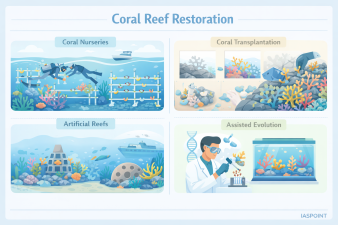
Restoration strategies are generally divided into physical methods (rebuilding the reef structure) and biological methods (repopulating coral colonies).
1. Biorock Technology (Mineral Accretion Technology)
Biorock is the most advanced physical restoration method currently used in India.
- Mechanism: A low-voltage electrical current is passed through a steel frame submerged on the seabed. This triggers a chemical reaction where dissolved minerals (calcium and magnesium) in seawater precipitate onto the frame, forming a limestone (CaCO3) coating similar to natural coral skeletons.
- Benefit: Corals transplanted onto Biorock grow 4 to 6 times faster and show higher resistance to thermal stress and pollution.
- Indian Application: First implemented by the Zoological Survey of India (ZSI) off the Mithapur coast in the Gulf of Kachchh (Gujarat) in 2020. Recent assessments in 2025-26 show successful recruitment of benthic fauna like sponges and mollusks.
2. Coral Gardening (Asexual Propagation)
- Process: This “nursery-based” approach involves collecting small fragments from healthy “donor” corals, growing them in underwater nurseries (on floating ropes or PVC frames), and then “outplanting” them onto degraded reefs.
- Indian Context: Widely used in the Gulf of Mannar and Palk Bay by the National Centre for Coastal Research (NCCR).
3. Larval Seeding (Sexual Propagation)
- Process: Collecting coral spawn (eggs and sperm) during mass spawning events, fertilizing them in labs, and releasing the larvae onto degraded reef areas to settle and grow.
- Status: This method promotes genetic diversity, which is crucial for long-term climate resilience.
Institutional Framework and Initiatives in India
The Ministry of Environment, Forest and Climate Change (MoEFCC) oversees restoration through various agencies and schemes.
National Coastal Mission (NCM)
The NCM provides the policy umbrella for coral conservation. Its key components include:
- Management Action Plans (MAPs): Specific plans for the four major coral regions (Andaman, Lakshadweep, Gulf of Mannar, Gulf of Kachchh).
- Research & Development: Funding for institutions like ZSI, NCCR, and the Central Marine Fisheries Research Institute (CMFRI).
Marine Protected Areas (MPAs)
Restoration is most effective within legally protected zones under the Wildlife Protection Act, 1972 (Schedule I).
- Gulf of Mannar Marine National Park: A pioneer in reef transplantation.
- Marine National Park (Jamnagar): Focuses on Biorock and mitigating sedimentation.
- Mahatma Gandhi Marine National Park (Andaman): Monitors recovery after bleaching events.
Strategic Restoration Projects and Facts
| Project/Method | Location | Key Detail for Prelims |
| Biorock Implementation | Gulf of Kachchh (Mithapur) | First of its kind in India; uses solar-powered electrodes. |
| Staghorn Recovery | Gulf of Kachchh | Acropora species (extinct in the region for 10k years) were successfully reintroduced from the Gulf of Mannar. |
| MISHTI Integration | PAN India | While focused on mangroves, the scheme’s funding is being explored for integrated “Bio-shield” restoration including reefs. |
| Climate Resilient Corals | Gulf of Mannar | Research into “Assisted Evolution” to identify corals that survive higher sea surface temperatures. |
Challenges to Restoration Success
Despite technological gains, restoration faces significant hurdles:
- Scale vs. Cost: Biorock and lab-based nurseries are expensive and currently cover only small fractions of total reef areas.
- Water Quality: High turbidity and sedimentation (common in the Gulf of Kachchh) can smother new transplants.
- Frequency of Bleaching: As of April 2024, NOAA confirmed the 4th global bleaching event. Restoration cannot keep pace if mass mortality occurs every 2-3 years.
- Ocean Acidification: Decreasing pH levels hinder the ability of corals (and Biorock frames) to maintain calcium carbonate structures.
Trivia for UPSC Prelims
- Zooxanthellae: These algae provide up to 90% of a coral’s energy. Restoration fails if the water is too turbid for these algae to photosynthesize.
- Blue Carbon: While mangroves are major carbon sinks, coral reefs are often considered carbon neutral in the short term because the calcification process actually releases a small amount of CO2. Their value lies in biodiversity and coastal protection.
- Biorock Inventor: Developed by Wolf Hilbertz and Thomas J. Goreau; the latter has consulted on Indian projects.