
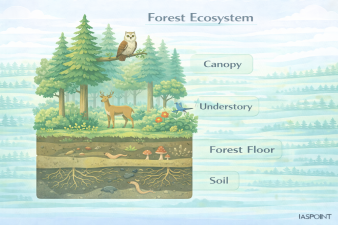
A forest ecosystem is a functional unit of nature where biotic components (plants, animals, microorganisms) interact with abiotic factors (soil, climate, water) to form a complex web of life. It is the most diverse terrestrial ecosystem, characterized by high biomass and vertical stratification.
Classification of Indian Forests (Champion and Seth, 1968)
The classification by Sir H.G. Champion and S.K. Seth remains the most authoritative framework for Indian forestry, dividing forests into 16 major groups based on climate, soil, and vegetation.
1. Tropical Wet Evergreen Forests
- Climate: Rainfall exceeds 250 cm; temperature ranges from 25°C to 27°C.
- Location: Western Ghats (windward side), Andaman and Nicobar Islands, and parts of North-East India.
- Vegetation: Multi-layered canopy (stratification); trees do not shed leaves at the same time.
- Species: Mesua, White Cedar, Toon, Dhup, Hopea.
2. Tropical Semi-Evergreen Forests
- Climate: Rainfall between 200 cm and 250 cm.
- Location: Transitional zones between evergreen and deciduous forests; Western Ghats and Assam.
- Species: Arjun, Laurel, Haldu, Rosewood.
3. Tropical Moist Deciduous Forests
- Climate: Rainfall between 100 cm and 200 cm.
- Location: Foothills of Himalayas, Eastern slopes of Western Ghats, Odisha, and Chhattisgarh.
- Significance: Most commercially exploited forests in India.
- Species: Teak, Sal, Shisham, Hurra, Mahua, Amla.
4. Tropical Dry Deciduous Forests
- Climate: Rainfall between 70 cm and 100 cm.
- Location: Rainier parts of Peninsular India and plains of Uttar Pradesh and Bihar.
- Vegetation: Large tracts of open grass are common between trees.
- Species: Tendu, Palas, Amaltas, Bel, Khair.
5. Tropical Thorn Forests
- Climate: Rainfall less than 50 cm.
- Location: Semi-arid areas of South-West Punjab, Haryana, Rajasthan, Gujarat, and Madhya Pradesh.
- Vegetation: Xerophytic adaptations; small leaves and thick bark.
- Species: Babool, Ber, Wild Date Palm, Khair, Neem, Khejri.
6. Montane Forests
- Himalayan Moist Temperate: Found between 1500-3000 m. Features Oak, Fir, Spruce, and Deodar.
- Montane Wet Temperate: Found in higher hills of Kerala and Tamil Nadu (Nilgiris, Palani, Anaimalai) known as Sholas.
- Alpine Forests: Found above 3000 m. Features Silver fir, Junipers, Pine, and Birches.
Key Findings of India State of Forest Report (ISFR) 2023-2025
The Forest Survey of India (FSI) releases the ISFR biennially. Current data highlights the following:
| Indicator | Value / Rank |
| Total Forest and Tree Cover | 25.17% of Geographical Area (GA) |
| Total Forest Cover | 21.76% of GA |
| Global Rank (Total Forest Area) | 9th (as per GFRA 2025) |
| Global Rank (Net Forest Gain) | 3rd |
| States with Largest Forest Area | Madhya Pradesh > Arunachal Pradesh > Chhattisgarh |
| States with Highest Forest % | Mizoram (85.34%) > Arunachal Pradesh > Meghalaya |
| Carbon Stock | Estimated at 7,285.5 Million Tonnes |
Ecological and Economic Significance
Carbon Sequestration
Forests act as massive carbon sinks. India ranked 5th globally for net carbon removals between 2021 and 2025, removing approximately 150 Mt of CO2 annually.
Mangrove Ecosystems
India’s mangrove cover stands at approximately 4,992 sq km. These forests protect coastal regions from tsunamis, storms, and soil erosion. West Bengal (Sundarbans) holds the highest percentage of mangrove cover.
Livelihood Support
Non-Timber Forest Products (NTFPs) like Tendu leaves, Lac, Resins, and medicinal plants support the livelihoods of over 27.5 million people in rural India.
Forest Protection and Governance Framework
Constitutional Provisions
- Article 48A (DPSP): The State shall endeavor to protect and improve the environment and to safeguard the forests and wildlife.
- Article 51A(g) (Fundamental Duty): To protect and improve the natural environment including forests, lakes, rivers, and wildlife.
- 42nd Amendment Act, 1976: Moved “Forests” from the State List to the Concurrent List.
Legislative Framework
- Indian Forest Act, 1927: Governs the movement of timber and forest produce. Categorizes forests into Reserved, Protected, and Village forests.
- Forest (Conservation) Act, 1980: Prohibits the use of forest land for non-forest purposes without prior Central Government approval.
- Forest Rights Act (FRA), 2006: Recognizes the rights of Forest Dwelling Scheduled Tribes (FDST) and Other Traditional Forest Dwellers (OTFD) over land and resources.
Threats and Conservation Challenges
Forest Fires
Approximately 35.47% of India’s forest cover is prone to fires. The fire season usually lasts from November to June.
- Impact: Destruction of organic matter, loss of biodiversity, and release of GHGs like CO, CH4, and NOx.
- Solution: FSI’s Forest Fire Alert System (FFAS) provides real-time satellite monitoring.
Invasive Species
Species like Lantana Camara and Prosopis juliflora have degraded native forest ecosystems, reducing the availability of fodder for herbivores and altering soil chemistry.
Important Facts for Prelims
- Sholas: High-altitude stunted evergreen forests in the Western Ghats, separated by grasslands.
- Bonn Challenge: India’s commitment to restore 26 million hectares of degraded and deforested land by 2030.
- Sacred Groves: Community-protected forest fragments (e.g., Sarnas in Jharkhand, Kavus in Kerala) that act as biodiversity hotspots.
- T.N. Godavarman Case (1996): The Supreme Court gave a broad definition of “forest” to include all areas recorded as forest in government records, regardless of ownership.