
Environmental refugees are individuals who are forced to leave their traditional habitat, temporarily or permanently, because of a marked environmental disruption (natural and/or triggered by people) that jeopardized their existence and/or seriously affected the quality of their life. Unlike “Economic Migrants,” these individuals do not move by choice to seek better opportunities but are pushed by ecological necessity.
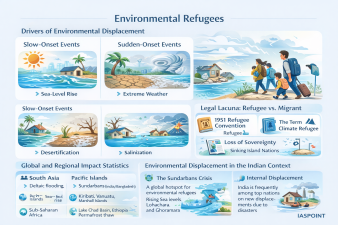
Drivers of Environmental Displacement
The factors leading to the creation of environmental refugees are categorized into slow-onset and sudden-onset events.
Slow-Onset Events
These are gradual environmental changes that make an area uninhabitable over years or decades.
- Sea-Level Rise: Threatens low-lying island nations (e.g., Kiribati, Tuvalu) and coastal deltas.
- Desertification: The loss of productive land in arid and semi-arid regions, particularly in the Sahel region of Africa.
- Salinization: The intrusion of saltwater into agricultural land, rendering it unfit for crops, common in the Sundarbans.
Sudden-Onset Events
These are immediate disasters that cause mass displacement in a matter of hours or days.
- Extreme Weather Events: Intensified cyclones, hurricanes, and typhoons (e.g., Cyclone Amphan).
- Flooding: Frequent and catastrophic flooding in riverine basins like the Brahmaputra or the Nile.
- Geological Hazards: Massive earthquakes or volcanic eruptions that destroy entire settlements.
The Legal Lacuna: Refugee vs. Migrant
A critical challenge for environmental refugees is the lack of formal recognition under international law.
- 1951 Refugee Convention: The Geneva Convention defines a “refugee” as someone fleeing persecution based on race, religion, nationality, or membership in a particular social group. It does not recognize “environment” or “climate change” as a ground for seeking asylum.
- The Term “Climate Refugee”: While widely used by media and NGOs, it is not a legally binding term. International organizations like the IOM (International Organization for Migration) prefer “Environmental Migrant.”
- Loss of Sovereignty: For “Sinking Island Nations,” the displacement poses a unique legal question: can a state exist without a physical territory?
Global and Regional Impact Statistics
| Region | Vulnerability Factor | Noteworthy Example |
| South Asia | Deltaic flooding, Cyclones | Sundarbans (India/Bangladesh) |
| Pacific Islands | Sea-level rise | Kiribati, Vanuatu, Marshall Islands |
| Sub-Saharan Africa | Drought, Desertification | Lake Chad Basin, Ethiopia |
| Arctic | Permafrost thaw, Coastal erosion | Indigenous communities in Alaska |
Environmental Displacement in the Indian Context
India is one of the most vulnerable countries to climate-induced migration due to its diverse geography and high population density.
The Sundarbans Crisis
The Sundarbans, spanning West Bengal and Bangladesh, is a global hotspot for environmental refugees. Rising sea levels and frequent cyclones have led to the disappearance of islands like Lohachara and Ghoramara, forcing thousands to migrate to Kolkata or other urban centers as “climate-displaced” persons.
Internal Displacement
According to the Internal Displacement Monitoring Centre (IDMC), India often records the highest or second-highest number of new displacements due to disasters globally, frequently exceeding displacement caused by conflict.
The “Refugee” vs. “Illegal Immigrant” Debate
Environmental migration from Bangladesh into Northeast India is often conflated with political and economic migration, leading to complex socio-political tensions and challenges in implementing the National Register of Citizens (NRC).
International Initiatives and Frameworks
While no single treaty covers environmental refugees, several frameworks address the issue indirectly.
- Nansen Initiative (2012): A state-led consultative process aimed at building consensus on a protection agenda for people displaced across borders by disasters and climate change.
- Global Compact for Migration (2018): The first inter-governmentally negotiated agreement to cover all dimensions of international migration, which explicitly recognizes climate change as a driver of migration.
- Peninsula Principles (2013): Provides a comprehensive legal framework for the protection of the rights of “Climate Displaced Persons” within their own countries.
Trivia and Factoids for UPSC Prelims
- First Climate Refugees: The residents of the Carteret Islands in Papua New Guinea are often cited as the first community to be officially relocated due to sea-level rise.
- The Kiribati Purchase: In 2014, the government of Kiribati purchased 20 sq km of land in Fiji to ensure “migration with dignity” for its citizens as their own islands sink.
- Groundswell Report: A World Bank report which predicts that by 2050, climate change could force 216 million people to move within their own countries across six world regions.
- Environmental Determinism: The geographical theory that suggests the physical environment sets limits on human social development, often discussed in the context of forced migration.