
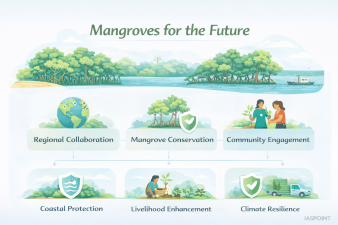
Mangroves for the Future (MFF) is a unique, partnership-based regional initiative focused on the sustainable management of coastal ecosystems. While “mangroves” are its flagship, the program encompasses all coastal ecosystems including coral reefs, wetlands, forests, lagoons, seagrasses, and sandy beaches. It was established in 2006, primarily as a response to the devastating 2004 Indian Ocean Tsunami, to build “natural infrastructure” and enhance the resilience of coastal communities.
Core Institutional Framework and Governance
The MFF is co-chaired by the International Union for Conservation of Nature (IUCN) and the United Nations Development Programme (UNDP). The initiative operates through a decentralized structure to ensure local relevance and regional cooperation.
Key Member Countries
Originally focused on the six nations most severely impacted by the 2004 tsunami, the initiative has since expanded.
- Founding Members: India, Indonesia, Maldives, Seychelles, Sri Lanka, and Thailand.
- Outreach/Expanded Members: Bangladesh, Cambodia, Myanmar, Pakistan, and Vietnam.
Institutional Partners
The initiative is supported by a broad coalition including:
- Multilateral Agencies: FAO, UNEP.
- Civil Society: CARE International, Wetlands International.
- Donors: Sida (Sweden), Norad (Norway), and DANIDA (Denmark).
Strategic Objectives and Focus Areas
MFF operates on a “Knowledge-Empowerment-Governance” framework to achieve long-term sustainability.
Knowledge Management
- Generating and disseminating scientific data on coastal ecosystems.
- Enhancing the information base to support evidence-based policy making.
- Promoting the exchange of best practices across the Indian Ocean region.
Stakeholder Empowerment
- Providing financial support through Small, Medium, and Large Grant Facilities.
- Strengthening the capacity of civil society and the private sector to manage coastal resources.
- Promoting sustainable livelihoods that reduce dependency on exploitative practices.
Governance Strengthening
- Encouraging Integrated Coastal Management (ICM) at national levels.
- Fostering multi-stakeholder forums to include local communities in decision-making.
- Engaging the private sector to adopt “Blue Economy” principles and responsible business practices.
MFF in the Indian Context
India is a leading member of MFF and manages its national program through a National Coordinating Body (NCB) chaired by the Ministry of Environment, Forest and Climate Change (MoEFCC).
Key Implementation Sites
- Gujarat: Gulf of Kutch and Marine National Park.
- Odisha: Bhitarkanika and Mahanadi Delta.
- West Bengal: Sundarbans (World’s largest mangrove forest).
- Andaman and Nicobar Islands: High-density mangrove regions.
- Tamil Nadu: Pichavaram and Gulf of Mannar.
Alignment with National Schemes
The goals of MFF in India are bolstered by domestic initiatives:
- MISHTI Scheme (2023): Mangrove Initiative for Shoreline Habitats & Tangible Incomes.
- National Coastal Mission: Part of the National Action Plan on Climate Change (NAPCC).
- Blue Flag Certification: Aimed at sustainable beach management.
Scientific and Ecological Trivia for Prelims
| Feature | Details for UPSC Prelims |
| Adaptations | Pneumatophores (breathing roots), Viviparity (seeds germinate on tree), and Salt Glands (excreting excess salt). |
| Carbon Value | Mangroves sequester 2 to 4 times more carbon than terrestrial forests; they are termed “Blue Carbon” sinks. |
| Bio-shield | Dense mangrove roots can reduce wave energy by up to 70% during storm surges. |
| Biodiversity | Sundarbans is the only mangrove habitat in the world inhabited by the Royal Bengal Tiger. |
| Global Status | Indonesia holds the largest mangrove area globally; India is among the top 10. |
Cross-Cutting Issues in MFF
MFF integrates several modern environmental challenges into its core strategy:
- Climate Change: Focus on both mitigation (carbon sinks) and adaptation (coastal buffers).
- Gender Equality: Ensuring women’s participation in coastal resource management and livelihood programs.
- Disaster Risk Reduction (DRR): Utilizing mangroves as a first line of defense against cyclones and tsunamis.
- Property Rights: Addressing land tenure issues in coastal zones to ensure community-led conservation