
In the context of the Disaster Management (DM) cycle, Preparedness refers to the knowledge and capacities developed by governments, professional response and recovery organizations, communities, and individuals to effectively anticipate, respond to, and recover from the impacts of likely, imminent, or current hazard events or conditions. Unlike mitigation, which seeks to prevent or reduce the impact of a disaster, preparedness focuses on the readiness to handle the disaster once it strikes.
Legislative and Institutional Framework in India
The legal backbone for preparedness in India is the Disaster Management Act, 2005, which shifted the national approach from relief-centric to a proactive, holistic, and integrated model.
- National Disaster Management Authority (NDMA): The apex body chaired by the Prime Minister, responsible for laying down policies and guidelines for preparedness.
- National Disaster Response Force (NDRF): A specialized force constituted under Section 44 of the DM Act for a professional response to disasters. It currently consists of 16 battalions organized on paramilitary lines.
- National Institute of Disaster Management (NIDM): Tasked with human resource development, capacity building, and training for disaster preparedness.
- State and District Authorities (SDMA/DDMA): Decentralized bodies ensure that preparedness reaches the grassroots level through District Disaster Management Plans (DDMP).
Key Components of Disaster Preparedness
A 360-degree preparedness strategy involves multiple layers of planning and execution:
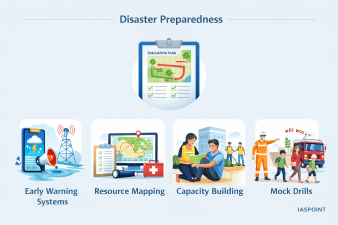
Early Warning Systems (EWS)
Early warning is the pivot of preparedness. India utilizes several tech-driven platforms:
- Indian Ocean Tsunami Early Warning Centre (ITEWC): Established at INCOIS, Hyderabad, providing alerts for the Indian Ocean region.
- Sagar Vani: An integrated information dissemination system for ocean state forecasts.
- Common Alerting Protocol (CAP): A geo-targeted SMS alert system developed by C-DOT for localized warnings.
- Mausam App: Real-time weather updates provided by the India Meteorological Department (IMD).
Resource Mapping and Inventory Management
- India Disaster Resource Network (IDRN): A nation-wide electronic inventory of resources (equipment, human resources, and critical supplies) available at the district level to ensure quick mobilization during emergencies.
Capacity Building and Mock Drills
- Community Based Disaster Risk Management (CBDRM): Training local volunteers (Aapda Mitras) to act as first responders.
- Annual Mock Drills: Conducted by NDMA and NDRF across schools, hospitals, and industrial clusters to test the efficacy of the Response Business Continuity Plan.
Comparative Analysis: Preparedness vs. Mitigation
| Feature | Preparedness | Mitigation |
| Primary Goal | Enhancing response and recovery capability. | Reducing the long-term risk and impact. |
| Timeline | Immediate actions taken before or during a disaster. | Ongoing long-term measures. |
| Examples | Evacuation plans, stockpiling, mock drills. | Hazard mapping, building codes, reforestation. |
| Focus | Human and organizational readiness. | Physical and structural resilience. |
Sector-Specific Preparedness Strategies
1. Health and Medical Preparedness
- Mass Casualty Management (MCM): Training medical personnel in triage—the process of prioritizing patients based on the severity of their condition.
- Mobile Medical Units (MMUs): Deployment of pre-equipped containerized hospitals (like the BHISHM Cube under Project ARYOGYA MAITRI) to disaster zones.
2. Infrastructure and Communication
- Redundancy in Communication: Deployment of Satellite phones and HAM Radio (Amateur Radio) networks when conventional towers fail.
- Safe Shelters: Construction of Multi-purpose Cyclone Shelters (MPCS) in coastal states like Odisha and Andhra Pradesh.
Global Frameworks Guiding Indian Preparedness
- Sendai Framework (2015-2030): The primary international agreement focusing on Disaster Risk Reduction (DRR). Priority 4 of the framework specifically emphasizes “Enhancing disaster preparedness for effective response.”
- Prime Minister’s 10-Point Agenda on DRR: Introduced at the Asian Ministerial Conference on Disaster Risk Reduction (AMCDRR) 2016, emphasizing local capacity building and the involvement of women in disaster leadership.
Crucial Facts and Trivia for UPSC Prelims
- The “Golden Hour”: The first hour after a traumatic injury or disaster onset when prompt medical treatment has the highest likelihood of preventing death.
- Operation Dost: India’s 2023 disaster response mission to Turkey and Syria following a massive earthquake, showcasing international preparedness and “Disaster Diplomacy.”
- Bustee Level Committees: A unique grassroots preparedness model in Kolkata for managing fire risks in congested urban slums.
- Coalition for Disaster Resilient Infrastructure (CDRI): A global partnership launched by India in 2019 to promote the resilience of infrastructure systems to climate and disaster risks.
Challenges in Achieving 100% Preparedness
- Last Mile Connectivity: Ensuring that warnings reach the most remote or marginalized populations who may not have digital access.
- Urban Complexity: The “Urban Heat Island” effect and unplanned drainage systems complicate preparedness for urban flooding.
- Fund Allocation: Traditionally, funding has been skewed toward “Response and Relief” (15th Finance Commission recommended a shift to a 10% allocation for Preparedness and Capacity Building within the National Disaster Risk Management Fund).