
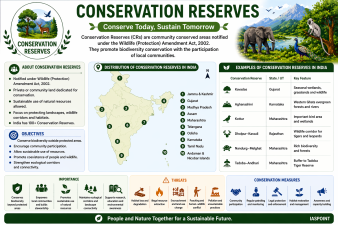
Conservation Reserves are a category of protected areas in India introduced through the Wildlife (Protection) Amendment Act, 2002. They act as buffer zones, connectors, or migration corridors between established National Parks, Wildlife Sanctuaries, and reserved forests.
- Legal Basis: Notified under Section 36A of the Wildlife (Protection) Act, 1972.
- Land Ownership: Unlike Community Reserves, the land in a Conservation Reserve is strictly owned by the Government.
- Purpose: To protect landscapes, seascapes, flora, fauna, and their habitats while ensuring the participation of local communities in conservation.
Governance and Management
The management of these reserves is unique due to its consultative nature, bridging the gap between state administration and local stakeholders.
- Conservation Reserve Management Committee: Under Section 36B, the State Government must constitute a committee to advise the Chief Wildlife Warden on conservation and management.
- Composition: Includes representatives from the Forest Department, one representative from each relevant Village Panchayat, and three representatives from non-governmental organizations (NGOs).
- Consultation: The State Government must consult local communities before declaring an area as a Conservation Reserve.
Statistics and Distribution
As of early 2026, India has over 115 Conservation Reserves covering significant ecological corridors.
| State/UT | Notable Conservation Reserve | Key Significance |
| Jammu & Kashmir | Pampore Marsh | Famous for Saffron cultivation nearby; critical for migratory waterfowl. |
| Rajasthan | Shakambhari | Largest Conservation Reserve in Rajasthan; located in the Aravalli range. |
| Punjab | Beas River | Only habitat in India for the Indus River Dolphin; critical for riverine ecology. |
| Tamil Nadu | Tiruppadaimarathur | India’s first Conservation Reserve (notified in 2005); recognized for its heronry. |
| Maharashtra | Tillari | Acts as a vital corridor connecting Sahyadri Tiger Reserve and Mollem (Goa). |
| Karnataka | Bankapura Peacock | One of the few reserves dedicated specifically to the conservation of the Indian Peafowl. |
Differences Between Protected Area Categories
For UPSC Prelims, it is essential to distinguish Conservation Reserves from other similar designations:
- Conservation vs. Community Reserves: In Conservation Reserves, the land is government-owned. In Community Reserves (Section 36C), the land is owned by individuals or communities who have volunteered to conserve wildlife.
- Rights of People: Unlike National Parks where rights are strictly extinguished, Conservation Reserves allow for regulated human activities and traditional rights, provided they do not conflict with wildlife conservation.
- Legal Status: They provide a lower level of protection than National Parks but higher than standard “Reserved Forests” due to the specific focus on wildlife and habitat management.
Ecological Importance
- Corridor Management: They prevent “habitat fragmentation” by maintaining the genetic flow between isolated wildlife populations (e.g., the Kaniyan-Pura Reserve connects Bandipur and BRT Tiger Reserves).
- Protection of Non-Flagship Species: Often focus on lesser-known species or specific ecosystems like grasslands and community-managed wetlands.
- Stakeholder Participation: By involving the Management Committee, it reduces man-animal conflict and promotes “social fencing” of protected areas.
Key Trivia for Aspirants
- First Site: Tiruppadaimarathur Conservation Reserve in Tirunelveli, Tamil Nadu, was the first to be notified in India.
- Indus Dolphin Habitat: The Beas River Conservation Reserve in Punjab is the only place in India where the endangered Indus River Dolphin is found.
- Blackbuck Habitat: The Ganjam District in Odisha uses conservation reserves effectively to protect Blackbucks through community-state cooperation.
- Marine Conservation: The Dugong Conservation Reserve in Palk Bay (Tamil Nadu) is a specialized marine site established to protect the “Sea Cow.”