

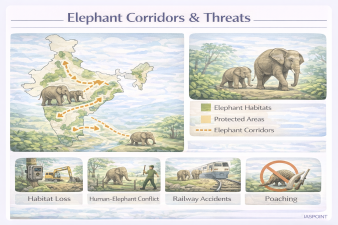
Elephant corridors are narrow strips of land that serve as conduit habitat, connecting two or more larger habitats of elephant populations. These corridors are essential for the survival of the species, as they prevent genetic isolation by allowing gene flow between different herds and reduce Human-Elephant Conflict (HEC) by providing safe passage through human-dominated landscapes.
Key Characteristics and Statistics
The identification and securing of corridors are central to the “Right of Passage” strategy adopted by the Ministry of Environment, Forest and Climate Change (MoEFCC) and conservation partners like the Wildlife Trust of India (WTI).
- Total Number: According to the “Elephant Corridors of India 2023” report, there are 150 identified elephant corridors in India.
- Regional Distribution: * West Bengal has the highest number of corridors (approx. 26).
- The East-Central region (Jharkhand, Odisha, Chhattisgarh) accounts for a significant portion of active corridors.
- Southern India (Karnataka, Tamil Nadu, Kerala) holds the most ecologically stable corridors within the Nilgiri Biosphere Reserve.
- Legal Status: Corridors do not have a specific legal definition under the Wildlife Protection Act, 1972, but they are managed under the umbrella of “Elephant Reserves.”
Major Threats to Elephant Corridors
The integrity of these biological bridges is under constant pressure from anthropogenic activities, leading to fragmentation.
1. Infrastructure and Linear Projects
- Railway Tracks: High-speed train routes passing through corridors (e.g., Siliguri-Alipurduar line) lead to frequent “accidental” deaths.
- Highways and Canals: National Highways (NH) and irrigation canals act as physical barriers, often forcing elephants into villages.
- Power Lines: Low-hanging high-tension wires are a primary cause of elephant mortality due to electrocution.
2. Land Use Change and Encroachment
- Agricultural Expansion: Conversion of forest fringes into crop fields (sugarcane, paddy) attracts elephants, leading to crop raiding.
- Urbanization: Growth of settlements and “homestays” or resorts within corridor areas, particularly in places like Wayanad and the Nilgiris.
- Mining: Open-cast mining in Odisha and Chhattisgarh destroys traditional migratory paths and degrades habitat quality.
3. Habitat Fragmentation
- When large habitats are broken into smaller patches, it leads to the “Island Effect,” where small populations become inbred, reducing biological fitness and increasing the risk of local extinction.
Classification of Corridors based on Feasibility
Conservationists categorize corridors to prioritize protection efforts:
| Category | Description | Priority Level |
|---|---|---|
| High Ecological Priority | Regularly used by herds; connects two major protected areas. | Level 1 |
| Medium Ecological Priority | Used occasionally or by bull elephants; high human activity. | Level 2 |
| Highly Threatened | Facing imminent blockage due to permanent infrastructure (factories, mines). | Urgent Intervention |
Conservation Strategies and Mitigation Measures
The government and NGOs employ several technical and social strategies to secure these passages.
- Securing the “Right of Passage”: This involves the state purchasing private land or encouraging voluntary relocation of communities living within the corridor.
- Eco-Bridges and Underpasses: Constructing specialized structures like the long underpass on NH-44 (Kanha-Pench Corridor) to allow wildlife to cross roads safely.
- AI-Based Monitoring: Using sensors and AI cameras near railway tracks (e.g., the Gajraj System) to alert loco-pilots about elephant presence.
- Legal Intervention: The Supreme Court of India has played a pivotal role, notably in the Sigur Plateau case, where it ordered the demolition of illegal resorts to restore the Nilgiri elephant corridor.
Facts and Trivia for Prelims
- Keystone Species: Elephants are called “Architects of the Forest” because they create corridors used by other smaller animals.
- The 2023 Report: The latest MoEFCC report noted an increase in the number of corridors from 88 (in 2017) to 150, largely due to better documentation and shifting migration patterns.
- Interstate Corridors: Many corridors are trans-boundary, requiring cooperation between states (e.g., Karnataka-Tamil Nadu or Odisha-West Bengal).
- International Corridors: India shares elephant corridors with neighboring countries including Nepal, Bhutan, and Bangladesh, necessitating international conservation diplomacy.