
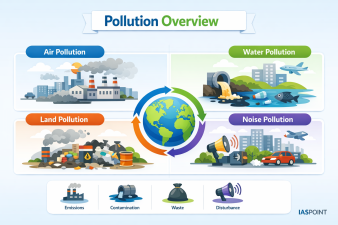
Environmental pollution refers to the introduction of harmful substances or contaminants into the natural environment, causing adverse changes.
Classification of Pollutants
Pollutants are categorized based on their nature, persistence, and origin.
By Nature of Disposal
- Biodegradable Pollutants: Waste units that can be broken down by microbial action (e.g., domestic sewage, agricultural residue).
- Non-Biodegradable Pollutants: Substances that do not degrade or degrade very slowly (e.g., DDT, plastics, heavy metals like Mercury and Lead).
By Origin
- Primary Pollutants: Emitted directly from a source in the form they were produced (e.g., CO, CO2, SO2, Particulate Matter).
- Secondary Pollutants: Formed in the atmosphere through chemical reactions between primary pollutants (e.g., Ground-level Ozone (O3), Peroxyacetyl Nitrate (PAN), Smog).
Major Types of Pollution and Sources
| Type | Major Pollutants | Primary Sources | Key Facts for Prelims |
| Air | PM2.5, PM10, SOx, NOx, CO, NH3 | Thermal power plants, vehicular exhaust, stubble burning. | National Ambient Air Quality Standards (NAAQS) cover 12 pollutants. |
| Water | Pathogens, Nitrates, Heavy Metals, BOD | Industrial effluents, surface runoff (fertilizers), domestic sewage. | Biological Oxygen Demand (BOD) measures organic pollution levels. |
| Soil | Pesticides, Plastic, Industrial Sludge | Excessive chemical farming, landfills, mining activities. | Soil Health Card Scheme aims to check nutrient decline. |
| Noise | Decibels (dB) | Construction, transport, loudspeakers. | Noise is regulated under the Air (Prevention and Control of Pollution) Act, 1981. |
Air Pollution: Standards and Indices
Air quality monitoring in India is governed by two primary frameworks that differ in their scope and purpose.
National Air Quality Index (AQI)
Launched in 2014 (“One Color-One Number-One Description”), it monitors 8 pollutants: PM10, PM2.5, NO2, SO2, CO, O3, NH3, and Pb. It categorizes air quality into six categories ranging from ‘Good’ to ‘Severe’.
WHO Air Quality Guidelines (2021) vs. Indian NAAQS
The World Health Organization (WHO) updated its guidelines in 2021, setting much stricter limits than India’s National Ambient Air Quality Standards (NAAQS).
| Pollutant | WHO Guideline (Annual) | India NAAQS (Annual) |
| PM2.5 | 5 μ g/m3 | 40 μ g/m3 |
| PM10 | 15 μ g/m3 | 60 μ g/m3 |
| NO2 | 10 μ g/m3 | 40 μ g/m3 |
Emerging Pollution Challenges
Beyond traditional categories, new forms of pollution have gained regulatory attention due to their long-term ecological impact.
Plastic and E-Waste
- Microplastics: Plastic particles less than 5mm in size, often entering the food chain through marine ecosystems.
- Extended Producer Responsibility (EPR): A policy approach under the Plastic Waste Management Rules (2021) and E-Waste Rules (2022) making producers responsible for the end-of-life management of their products.
- Single-Use Plastic Ban: India implemented a nationwide ban on identified single-use plastic items effective July 1, 2022.
Light and Thermal Pollution
- Light Pollution: Excessive artificial light that interferes with ecosystems and human circadian rhythms. It affects migratory birds and nocturnal insects.
- Thermal Pollution: Discharge of heated water from power plants into water bodies, reducing dissolved oxygen levels and causing “thermal shock” to aquatic life.
Institutional and Legislative Framework in India
Statutory Bodies
- Central Pollution Control Board (CPCB): Established in 1974 under the Water Act. It provides technical services to the Ministry of Environment, Forest and Climate Change (MoEFCC).
- National Green Tribunal (NGT): A specialized body equipped with expertise to handle environmental disputes. It is guided by the “Principle of Sustainable Development” and “Polluter Pays Principle.”
Key Legislations
- The Water (Prevention and Control of Pollution) Act, 1974: The first major environmental law in India.
- The Air (Prevention and Control of Pollution) Act, 1981: Expanded CPCB’s mandate to include air quality.
- The Environment (Protection) Act, 1986: An “umbrella” legislation enacted in the wake of the Bhopal Gas Tragedy to coordinate activities of various central and state authorities.
Global Conventions and Protocols
India is a signatory to several international treaties aimed at cross-border pollution control.
- Stockholm Convention: Focuses on Persistent Organic Pollutants (POPs). India has banned several “dirty dozen” chemicals under this.
- Basel Convention: Regulates the transboundary movement of hazardous wastes and their disposal.
- Rotterdam Convention: Relates to the Prior Informed Consent (PIC) procedure for certain hazardous chemicals and pesticides in international trade.
- Minamata Convention: A global treaty to protect human health and the environment from the adverse effects of Mercury.
- Montreal Protocol: Successful global agreement to phase out Ozone Depleting Substances (ODS) like CF