
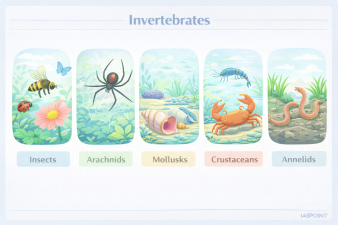
Invertebrates constitute approximately 95-97% of all animal species on Earth and about 80% of India’s faunal diversity.
Major Invertebrate Phyla and Key Characteristics
The following table summarizes the primary phyla essential for understanding ecological niches and biodiversity.
| Phylum | Common Examples | Distinctive UPSC Facts |
| Arthropoda | Insects, Crabs, Spiders | Largest phylum; possess jointed legs and chitinous exoskeletons. |
| Mollusca | Snails, Octopuses, Squids | Second largest phylum; many possess calcareous shells. |
| Cnidaria | Corals, Jellyfish, Anemones | Key for “Coral Bleaching” studies; possess stinging cells (nematocysts). |
| Porifera | Sponges | Multicellular organisms with pores (ostia) for water circulation; lack true tissues. |
| Echinodermata | Starfish, Sea Urchins | Exclusively marine; possess a water vascular system for locomotion. |
| Annelida | Earthworms, Leeches | Segmented bodies; vital for soil aeration and vermicomposting. |
Focus Area: Corals and Marine Invertebrates
Corals are sedentary marine invertebrates (Cnidarians) that live in a symbiotic relationship with Zooxanthellae (algae).
- Symbiosis: The algae provide food via photosynthesis, while the coral provides protection and nutrients.
- Coral Bleaching: Occurs when corals expel algae due to thermal stress (rising Sea Surface Temperatures), leading to a loss of color and source of nutrition.
- India’s Coral Hubs: Gulf of Mannar, Andaman and Nicobar Islands, Lakshadweep (Atolls), and Gulf of Kutch.
- Legal Status: All reef-building corals are protected under Schedule I of the Wildlife Protection Act, 1972.
Insects and Ecological Services
Insects are the most diverse group within the Arthropoda phylum and perform irreplaceable roles in the Indian agriculture and forest sectors.
- Pollinators: Bees, butterflies, and moths are responsible for the pollination of over 75% of global food crops. The “Colony Collapse Disorder” (CCD) in bees is a major environmental concern.
- Decomposers: Termites and beetles break down organic matter, recycling nutrients back into the soil.
- Indicators of Water Quality: Benthic macroinvertebrates like Mayflies and Stoneflies are used to assess the biological health of rivers like the Ganga.
Important Invertebrates in News and Conservation
Several invertebrates have gained prominence due to their endangered status or unique biological properties.
The Coconut Crab (Birgus latro)
- Status: Largest terrestrial arthropod in the world.
- Location: In India, they are primarily found in the Andaman and Nicobar Islands.
- Protection: Listed under Schedule I of the WPA, 1972.
Horseshoe Crabs
- Trivia: Often called “Living Fossils” because they have remained unchanged for millions of years.
- Medical Use: Their blue blood contains Amoebocyte Lysate, used to test vaccines and medical equipment for bacterial contamination.
- Habitat: Found along the Odisha and West Bengal coasts.
Schedule I Invertebrates (WPA, 1972)
Contrary to popular belief, the WPA does not just protect tigers and elephants. It includes:
- Butterflies: Such as the Crimson Rose, Kaiser-i-Hind, and Malabar Banded Swallowtail.
- Molluscs: Certain species of Gastropods (e.g., Cassis cornuta) and Bivalves.
- Sea Cucumbers: Highly poached for the illegal international food market; the first “Sea Cucumber Conservation Reserve” was established in Lakshadweep.
Threats to Invertebrate Diversity
- Pesticide Runoff: Neonicotinoids are particularly lethal to pollinators.
- Ocean Acidification: Increased CO2 absorption by oceans lowers pH levels, hindering calcification in molluscs and corals.
- Invasive Species: Species like the Giant African Snail outcompete local Indian snails and damage crops.
- Climate Change: Shifting phenology (timing of life events) leads to a mismatch between flowering plants and their specific insect pollinators.