
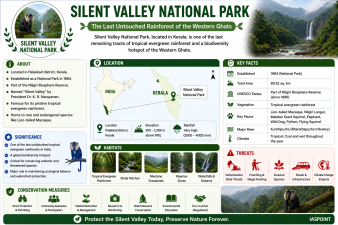
Silent Valley National Park is a pristine representative of the Western Ghats rainforests, located in the Palakkad district of Kerala. It is one of the last undisturbed tracts of South Western Ghats mountain rain forests and tropical moist evergreen forests in India.
- Establishment: It was formally inaugurated as a National Park in 1984 and notified in 1985.
- Buffer Zone: In 2007, an additional area was added as a buffer zone to enhance the ecological integrity of the core.
- Nilgiri Biosphere Reserve: It forms the core of the Nilgiri Biosphere Reserve, India’s first biosphere reserve.
- Geography: It is situated in the Kundali Hills. To the north, it borders the Nilambur South Forest Division, and to the south, the Palakkad Forest Division.
The “Silent Valley” Nomenclature
The name “Silent Valley” is derived from a perceived absence of the loud, buzzing calls of Cicadas, which are typically common in tropical forests.
- Mythological Connection: Locally known as Sairandhrivanam, it is associated with the legend of Draupadi (Sairandhri) from the Mahabharata.
- Riverine Link: The Kunthipuzha River flows through the entire 15 km length of the valley from north to south, never becoming turbid and remaining perennial.
The “Save Silent Valley” Movement
The park is a landmark in the history of Indian environmentalism.
- The Conflict: In the 1970s, the Kerala State Electricity Board proposed a hydroelectric dam across the Kunthipuzha River.
- The Protest: A massive public protest led by the Kerala Sastra Sahitya Parishad (KSSP) and activists like Sugathakumari highlighted the threat to the endangered Lion-tailed Macaque.
- Outcome: The project was scrapped in 1983 by Prime Minister Indira Gandhi, leading to the area’s declaration as a National Park.
Flora and Fauna Highlights
Silent Valley is recognized for its high degree of endemism and complex multi-layered vegetation.
| Species Category | Key Species |
| Flagship Mammal | Lion-tailed Macaque (Macaca silenus); one of the world’s rarest and most threatened primates. |
| Other Mammals | Nilgiri Tahr, Nilgiri Langur, Malabar Giant Squirrel, Tiger, Leopard, and Elephant. |
| Avifauna | Nilgiri Wood-pigeon, Malabar Whistling Thrush, and the Great Indian Hornbill. |
| Flora | Tropical Evergreen Forests; features ancient trees like Cullenia exarillata and rare Orchids and Ferns. |
Ecological Landscape and Climate
The park is characterized by its isolation, protected by high ridges on all sides.
- Vegetation Tiers: The park transitions from Tropical Evergreen Forests at lower altitudes to Subtropical Hill Forests and finally to Shola-Grassland ecosystems at the highest reaches.
- Rainfall: The valley receives heavy rainfall from both the Southwest and Northeast monsoons, often exceeding 5,000 mm annually.
- Absence of Human Habitation: Unlike many other Indian parks, there has been no history of human habitation (tribal or otherwise) within the core area of the valley.
Key Trivia for UPSC Prelims
- Kunthipuzha River: A tributary of the Bharathapuzha (Nila River), it is noted for its crystal-clear water and lack of silt.
- Endemism: The park is home to several species of flora and fauna found nowhere else on Earth, making it a critical “speciation centre.”
- The “Cullenia” Connection: The Cullenia exarillata tree is a key species as its fruits are the primary food source for the Lion-tailed Macaque.
- Attappady Reserve Forest: This forest forms the eastern border of the park and acts as a vital corridor for elephants.
Threats and Conservation
- Invasive Species: The spread of Eupatorium and other weeds in the buffer zones.
- Climate Change: Potential shifts in the Shola-grassland dynamics due to rising temperatures.
- Fragmentation: Maintaining the “corridor connectivity” with the Mukurthi National Park (Tamil Nadu) and the Nilambur forests is essential for large mammal movement.