
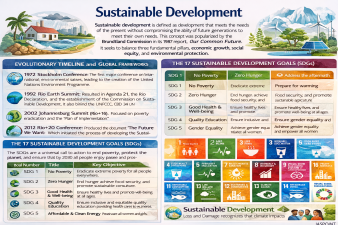
Sustainable development is defined as development that meets the needs of the present without compromising the ability of future generations to meet their own needs. This concept was popularized by the Brundtland Commission in its 1987 report, Our Common Future. It seeks to balance three fundamental pillars: economic growth, social equity, and environmental protection.
Evolutionary Timeline and Global Frameworks
The global commitment to sustainability has evolved through several landmark conferences and agreements:
- 1972 Stockholm Conference: The first major conference on international environmental issues, leading to the creation of the United Nations Environment Programme (UNEP).
- 1992 Rio Earth Summit: Resulted in Agenda 21, the Rio Declaration, and the establishment of the Commission on Sustainable Development. It also birthed the UNFCCC, CBD, and UNCCD.
- 2002 Johannesburg Summit (Rio+10): Focused on poverty eradication and the “Plan of Implementation.”
- 2012 Rio+20 Conference: Produced the document “The Future We Want,” which initiated the process of developing the Sustainable Development Goals (SDGs).
- 2015 Sustainable Development Summit: Adoption of the 2030 Agenda for Sustainable Development, featuring 17 SDGs and 169 targets.
The 17 Sustainable Development Goals (SDGs)
The SDGs are a universal call to action to end poverty, protect the planet, and ensure that by 2030 all people enjoy peace and prosperity.
| Goal Number | Title | Key Objective |
| SDG 1 | No Poverty | Eradicate extreme poverty for all people everywhere. |
| SDG 2 | Zero Hunger | End hunger, achieve food security, and promote sustainable agriculture. |
| SDG 3 | Good Health & Well-being | Ensure healthy lives and promote well-being at all ages. |
| SDG 4 | Quality Education | Ensure inclusive and equitable quality education. |
| SDG 5 | Gender Equality | Achieve gender equality and empower all women and girls. |
| SDG 6 | Clean Water & Sanitation | Ensure availability and sustainable management of water. |
| SDG 7 | Affordable & Clean Energy | Ensure access to affordable, reliable, and modern energy. |
| SDG 8 | Decent Work & Economic Growth | Promote sustained, inclusive economic growth and productive employment. |
| SDG 9 | Industry, Innovation & Infrastructure | Build resilient infrastructure and foster innovation. |
| SDG 10 | Reduced Inequalities | Reduce inequality within and among countries. |
| SDG 11 | Sustainable Cities & Communities | Make cities inclusive, safe, resilient, and sustainable. |
| SDG 12 | Responsible Consumption | Ensure sustainable consumption and production patterns. |
| SDG 13 | Climate Action | Take urgent action to combat climate change and its impacts. |
| SDG 14 | Life Below Water | Conserve and sustainably use oceans and marine resources. |
| SDG 15 | Life on Land | Protect and restore terrestrial ecosystems and halt biodiversity loss. |
| SDG 16 | Peace, Justice & Institutions | Promote peaceful societies and provide access to justice. |
| SDG 17 | Partnerships for the Goals | Strengthen the means of implementation for global partnership. |
Measurement Indices and Reports
To track progress, various global and national indices have been developed:
Global Sustainable Development Report (GSDR)
Published by the UN, this report tracks global progress on the 17 goals. It uses the SDG Index and Dashboards to rank countries based on their overall performance across all goals.
SDG India Index
Developed by NITI Aayog in collaboration with the United Nations in India, this index tracks the progress of all States and Union Territories. It classifies them into four categories based on their score (0–100):
- Aspirant: 0–49
- Performer: 50–64
- Front Runner: 65–99
- Achiever: 100
India’s Institutional and Policy Initiatives
India has integrated SDG targets into its national development schemes (Sabka Saath, Sabka Vikas).
Key National Schemes Aligned with SDGs
- Swachh Bharat Mission (SDG 6): Aimed at achieving universal sanitation coverage and eliminating open defecation.
- Pradhan Mantri Jan Dhan Yojana (SDG 1, 8, 10): Enhancing financial inclusion for the unbanked population.
- Ayushman Bharat (SDG 3): World’s largest government-funded healthcare program providing health cover to vulnerable families.
- Jal Jeevan Mission (SDG 6): Providing functional household tap connections to all rural households.
- PM-KUSUM (SDG 7, 13): De-dieselizing the farm sector and enhancing solar energy capacity.
Resource Efficiency and Circular Economy
India is moving toward a circular economy model to decouple economic growth from resource consumption. The Ministry of Environment, Forest and Climate Change (MoEFCC) has notified Plastic Waste Management and E-Waste Management rules to emphasize Extended Producer Responsibility (EPR).
Environmental Conventions and India’s Commitments
India plays a pivotal role in international climate diplomacy through various conventions:
- UNFCCC (Climate Change): India’s Panchamrit targets announced at COP26 include achieving Net Zero by 2070 and reaching 500 GW non-fossil energy capacity by 2030.
- CBD (Biodiversity): India is a party to the Nagoya and Cartagena Protocols, focusing on access and benefit-sharing of biological resources.
- UNCCD (Desertification): India hosted COP14 of UNCCD and committed to restoring 26 million hectares of degraded land by 2030.
Critical Principles of Sustainability
- Intra-generational Equity: Ensuring justice and resource access among the people of the current generation (e.g., reducing the North-South divide).
- Inter-generational Equity: Ensuring the current generation leaves a planet no worse than the one they inherited.
- Common But Differentiated Responsibilities (CBDR): Acknowledging that while all states are responsible for environmental protection, developed nations bear a greater historical responsibility.
- Precautionary Principle: Taking action to prevent environmental degradation even if full scientific certainty is lacking.
- Polluter Pays Principle: Those who produce pollution should bear the costs of managing it to prevent damage to human health or the environment.
Fact-File for Competitive Examinations
- The term “Sustainable Development” was first used in the World Conservation Strategy (1980).
- The Three Es: Environment, Economy, and Equity are often called the “Triple Bottom Line.”
- Ecological Footprint: Measures how much biologically productive land and water an individual or population requires to produce the resources it consumes.
- Earth Overshoot Day: The date when humanity’s demand for ecological resources in a given year exceeds what Earth can regenerate in that year.
- Green GDP: An index of economic growth with the environmental consequences of that growth factored into a country’s conventional GDP.