
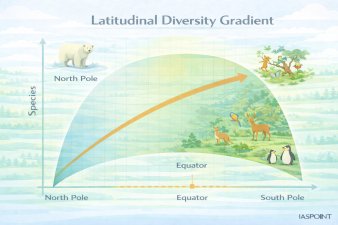
The Latitudinal Diversity Gradient is one of the most fundamental and recognized patterns in ecology. It refers to the observation that biodiversity is not distributed uniformly across the globe; rather, it increases steadily as one moves from the Poles toward the Equator.
Key Features of the Pattern
- Equatorial Peaks: Tropical regions (latitudes between $23.5$° N and $23.5$° S) harbor significantly more species than temperate or polar areas.
- Exceptions: While the pattern holds true for most taxa (birds, mammals, insects, plants), some groups like penguins, certain seals, and specific types of aphids show “inverse gradients” with higher diversity in higher latitudes.
Comparative Species Richness Examples
To highlight the intensity of the gradient, ecologists often compare specific taxa across different latitudes:
| Region | Latitude | Number of Bird Species |
| Colombia (Equator) | $0$° | ≈ 1,400 |
| India (Sub-tropical/Tropical) | $8$°N – $37$°N | > 1,200 |
| New York (Temperate) | $41$° N | $105$ |
| Greenland (Arctic) | $71$° N | $56$ |
- Fact: A forest in a tropical region like Ecuador has up to 10 times as many species of vascular plants as a forest of equal area in a temperate region like the Midwest USA.
Scientific Hypotheses for the Gradient
Ecologists suggest three primary reasons why the tropics are more diverse than the temperate regions:
1. Speciation and Time (Historical Stability)
- Temperate Regions: Have been subjected to frequent glaciations in the past, which wiped out species and forced frequent “restarts” of ecological succession.
- Tropical Latitudes: Have remained relatively undisturbed for millions of years. This long period of evolutionary stability allowed more time for species diversification and niche specialization.
2. Environmental Constancy and Predictability
- Seasonality: Tropical environments are less seasonal, more constant, and more predictable than temperate ones.
- Niche Specialization: Such constant environments promote niche specialization (narrower niches), allowing a greater number of species to coexist in the same area without competing each other to extinction.
3. Solar Energy and Productivity
- Insolation: The tropics receive more solar energy throughout the year.
- Productivity: Higher energy leads to higher Net Primary Productivity (NPP). Increased productivity can support a larger number of individuals and species, providing a broader base for the food web.
Implications for Conservation
The LDG is a primary reason why Biodiversity Hotspots are predominantly located in tropical regions (e.g., The Amazon, Western Ghats, Indo-Burma region).
- The Amazonian Rainforest: Often cited as the greatest biodiversity on Earth, it is home to more than $40,000$ species of plants, $3,000$ of fishes, $1,300$ of birds, $427$ of mammals, $427$ of amphibians, and $378$ of reptiles.
- Threat Factor: Because tropical species often have very narrow niches (specialization), they are frequently more vulnerable to climate change and habitat fragmentation than generalist temperate species.
UPSC Prelims Trivia: The Rapoport’s Rule
- Definition: An ecological hypothesis stating that the latitudinal ranges of plants and animals are generally smaller at low latitudes (tropics) than at high latitudes (poles).
- Correlation: This supports the LDG by suggesting that because tropical species have smaller ranges, you can “pack” more unique species into a single tropical area compared to a polar area.