
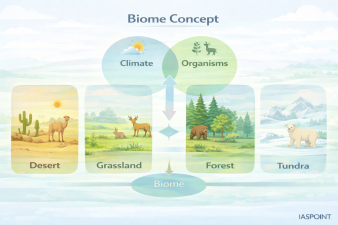
A biome is a large-scale terrestrial or aquatic ecosystem characterized by specific climatic conditions, soil types, and distinct communities of flora and fauna. While an ecosystem refers to the interaction between biotic and abiotic components in a specific area, a biome is a broader regional unit defined primarily by its climax vegetation and dominant climate.
Key Determinants of Biomes
The distribution of biomes is dictated by two primary climatic variables: Temperature and Precipitation. The variation in these factors across latitudes and altitudes creates distinct ecological zones.
- Insolation: The amount of solar energy received affects the metabolic rates of organisms.
- Altitude-Latitude Parallelism: Changes in vegetation observed while moving from the Equator to the Poles are often mirrored when ascending a high mountain (e.g., transitioning from tropical forest to alpine tundra).
Classification of Major Terrestrial Biomes
Terrestrial biomes are generally classified based on their latitude and the type of dominant vegetation they support.
| Biome Type | Latitudinal Zone | Primary Vegetation | Soil Type |
| Tundra | Arctic/High Altitude | Mosses, Lichens, Sedges | Permafrost (Cryosols) |
| Taiga (Boreal) | Sub-Arctic (50°-70° N) | Coniferous (Evergreen) | Podzols (Acidic/Nutrient poor) |
| Temperate Deciduous | Mid-Latitudes | Broad-leaf (Oak, Beech) | Alfisols (Rich in nutrients) |
| Tropical Rainforest | Equatorial (10°N – 10°S) | Multi-layered Broad-leaf | Latosols (Leached/Acidic) |
| Savanna | Tropical Wet-Dry | Grasses with scattered trees | Lateritic soils |
| Desert | Sub-tropical/Continental | Xerophytes (Cactus) | Aridisols (Saline/Sandy) |
Comprehensive Breakdown of Global Biomes
1. The Tundra Biome
Located beyond the 60° North latitude, this biome is characterized by a “treeless” landscape.
- Climate: Long, severe winters and very short summers. Low precipitation, mostly as snow.
- Flora: No deep-rooted plants due to Permafrost (permanently frozen subsoil). Vegetation includes reindeer moss, liverworts, and low shrubs.
- Fauna: Migratory birds, Arctic fox, Musk ox, and Polar bears.
- Trivia: The “Alpine Tundra” exists at high altitudes regardless of latitude, where night temperatures often fall below freezing.
2. Taiga or Boreal Forest Biome
The largest terrestrial biome, forming a continuous belt across North America and Eurasia.
- Vegetation: Dominated by needle-leaf coniferous trees like Pine, Spruce, and Fir. These trees are adapted to shed snow easily.
- Key Fact: The Taiga is absent in the Southern Hemisphere because there is no significant landmass at those latitudes (50°-70° S) to support it.
- Economic Significance: Major source of softwood for the global paper and pulp industry.
3. Temperate Deciduous Forest
Found in the Eastern USA, parts of Europe, China, and Japan.
- Characteristics: Trees shed their leaves in autumn to conserve water during the cold winter.
- Biodiversity: Moderate diversity compared to the tropics but higher than the Taiga. Common trees include Maple, Oak, and Hickory.
4. Tropical Rainforest Biome (The Selvas)
Located in the Amazon Basin, Congo Basin, and Indo-Malaysian region.
- Climate: High temperature ($27$°C average) and high rainfall (over $200$ cm) throughout the year. No distinct winter.
- Stratification: Characterized by distinct vertical layers: Emergent, Canopy, Understory, and Forest Floor.
- Epiphytes: High prevalence of plants that grow on other plants (e.g., Orchids) to reach sunlight.
- Soil Fact: Despite lush growth, the soil is nutrient-poor due to intense leaching caused by heavy rains.
5. Tropical Grasslands (Savanna)
A transitional biome between tropical forests and deserts.
- Vegetation: Known as “Big Game Country.” Features tall “Elephant grass” and scattered, fire-resistant trees like the Baobab and Acacia.
- Climate: Distinct wet and dry seasons. Fires are common and essential for maintaining the grassland by preventing forest encroachment.
6. Temperate Grasslands
Known by different names globally: Steppes (Eurasia), Prairies (North America), Pampas (Argentina), Veld (South Africa), and Downs (Australia).
- Soil: Extremely fertile Chernozem (Black Earth) soils, making these regions the “Granaries of the World.”
- Climate: Continental climate with extreme temperature variations.
7. Desert Biome
Occupies about one-fifth of Earth’s land surface.
- Types: Hot Deserts (Sahara, Thar) and Cold Deserts (Gobi, Ladakh).
- Adaptations: Plants (Xerophytes) have thick waxy cuticles, succulent stems, and long taproots. Animals are often nocturnal and excrete concentrated urine to conserve water.
Aquatic Biomes: A Brief Overview
Unlike terrestrial biomes, aquatic biomes are classified based on salinity and depth.
- Freshwater Biomes: Includes Lentic (standing water like lakes) and Lotic (running water like rivers) systems.
- Marine Biomes: Covers 71% of Earth’s surface. Includes Estuaries, Coral Reefs, and the Pelagic zone.
- Fact: The Photic Zone (up to 200m depth) is the most productive part of the marine biome as it allows photosynthesis.
Essential Facts for UPSC Prelims
- Ecotone: The transition zone between two biomes (e.g., a marshland between a river and a forest). It often has higher species richness, known as the Edge Effect.
- Ecological Equivalent: Unrelated organisms that occupy similar niches in different geographic biomes (e.g., Cacti in American deserts and Euphorbias in African deserts).
- Anthropogenic Biomes: Also known as “Anthromes,” these are biomes significantly altered by human activities, such as croplands and urban areas.