
The Sendai Framework for Disaster Risk Reduction (SFDRR) is a 15-year, voluntary, non-binding agreement that was adopted during the Third UN World Conference on Disaster Risk Reduction held in Sendai, Japan, in March 2015. It serves as the primary global blueprint for disaster risk reduction (DRR), succeeding the Hyogo Framework for Action (2005–2015). The framework aims for a substantial reduction in disaster risk and losses in lives, livelihoods, and health, as well as in the economic, physical, social, cultural, and environmental assets of persons, businesses, communities, and countries.
Core Priorities for Action
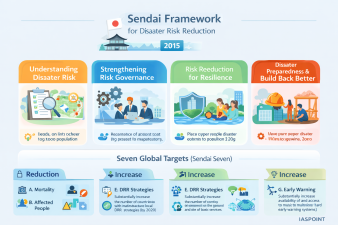
The framework shifts the focus from “disaster management” to “disaster risk management,” emphasizing the anticipation of long-term risk. It outlines four specific priorities for action to guide nations in their DRR efforts.
Priority 1: Understanding Disaster Risk
Disaster risk management should be based on an understanding of disaster risk in all its dimensions of vulnerability, capacity, exposure of persons and assets, hazard characteristics, and the environment. This knowledge is essential for pre-disaster risk assessment and for prevention and mitigation.
Priority 2: Strengthening Disaster Risk Governance
Governance at the national, regional, and global levels is vital for managing disaster risk. It includes clear vision, plans, competence, and coordination within and across sectors, as well as participation of relevant stakeholders to foster collaboration and partnership.
Priority 3: Investing in Disaster Risk Reduction for Resilience
Public and private investment in disaster risk prevention and reduction through structural and non-structural measures are essential to enhance the economic, social, health, and cultural resilience of persons, communities, and states.
Priority 4: Enhancing Disaster Preparedness and “Build Back Better”
The growth of disaster risk means there is a need to strengthen disaster preparedness for response and take action in anticipation of events. The recovery, rehabilitation, and reconstruction phase is a critical opportunity to “Build Back Better” by integrating disaster risk reduction into development measures.
The Seven Global Targets (Sendai Seven)
The framework sets seven global targets to be achieved by 2030. These are divided into four “reduction” targets and three “increase” targets.
| Target Type | Objective | Detail |
| Reduction | A: Mortality | Substantially reduce global disaster mortality per 100,000 population. |
| Reduction | B: Affected People | Substantially reduce the number of affected people globally. |
| Reduction | C: Economic Loss | Reduce direct disaster economic loss in relation to global GDP. |
| Reduction | D: Infrastructure | Substantially reduce disaster damage to critical infrastructure and disruption of basic services (health/education). |
| Increase | E: DRR Strategies | Substantially increase the number of countries with national and local DRR strategies (by 2020). |
| Increase | F: Int. Cooperation | Substantially enhance international cooperation to developing countries through sustainable support. |
| Increase | G: Early Warning | Substantially increase the availability of and access to multi-hazard early warning systems (MHEWS). |
Evolution: Hyogo vs. Sendai Framework
The transition from the Hyogo Framework (HFA) to the Sendai Framework (SFDRR) marked a significant paradigm shift in international disaster policy.
Shift from Response to Prevention
While the Hyogo Framework focused heavily on building the resilience of nations and increasing response capacity, the Sendai Framework prioritizes the management of risk itself. It moves beyond reacting to disasters to preventing the creation of new risks and reducing existing ones.
Broadened Scope of Hazards
The Sendai Framework expanded the scope of disaster risk reduction to include not only natural hazards but also man-made, environmental, technological, and biological hazards (such as pandemics).
Focus on Health and Cultural Heritage
SFDRR introduces a strong emphasis on the protection of health, cultural heritage, and the environment, which were less prominent in the predecessor framework.
Implementation in India
India is a signatory to the Sendai Framework and has taken proactive steps to align its national policies with the global targets.
National Disaster Management Plan (NDMP) 2016
India was one of the first countries in the world to launch a National Disaster Management Plan (NDMP) based on the Sendai Framework. Released in 2016 and updated in 2019, the plan aligns with the four priorities of Sendai and provides a framework for all phases of the disaster management cycle.
Prime Minister’s 10-Point Agenda on DRR
In 2016, the Prime Minister of India outlined a 10-point agenda for disaster risk reduction. Key points include:
- Encouraging all sectors to imbibe the principles of disaster risk management.
- Working towards risk coverage for all—from poor households to small and medium enterprises.
- Encouraging greater involvement and leadership of women in disaster risk management.
- Investing in mapping of risks globally to enhance the understanding of hazards.
Coalition for Disaster Resilient Infrastructure (CDRI)
Launched by India at the UN Climate Action Summit in 2019, CDRI is an international partnership that supports the Sendai Framework’s Target D. It aims to promote the resilience of infrastructure systems to climate and disaster risks.
Global Monitoring and Indicators
To track the progress of the seven targets, the UN Office for Disaster Risk Reduction (UNDRR) developed a set of 38 indicators.
The Sendai Framework Monitor
The Sendai Framework Monitor (SFM) is an online tool where member states self-report data against the 38 indicators. This process ensures transparency and accountability in achieving the 2030 goals.
Synergy with SDGs and Paris Agreement
The Sendai Framework is intricately linked with the 2030 Agenda for Sustainable Development. Goal 13 (Climate Action), Goal 11 (Sustainable Cities), and Goal 1 (End Poverty) all contain targets that overlap with the Sendai Framework, reinforcing the idea that disaster resilience is a prerequisite for sustainable development.
Last Modified: April 20, 2026