
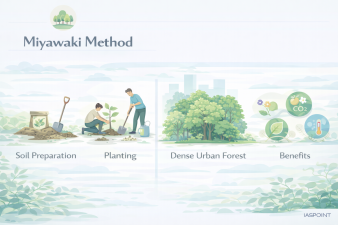
The Miyawaki method is a pioneering technique for ecological restoration and afforestation developed by the late Japanese botanist Akira Miyawaki. It focuses on creating “mini-forests” that grow significantly faster and are denser than traditional plantations.
Core Principles of the Miyawaki Technique
The method mimics the natural process of forest regeneration but accelerates it through specific soil and species management interventions.
- Pioneer Species Selection: It utilizes only native species of the region. A survey is conducted to identify the Potential Natural Vegetation (PNV) of the area.
- High Density: Seedlings are planted very close together (approx. 3 to 5 per square meter). This creates competition for sunlight, forcing the plants to grow upwards rapidly rather than sideways.
- Multi-Layered Structure: Unlike monoculture plantations, a Miyawaki forest consists of four layers:
- Shrub layer
- Sub-tree layer
- Tree layer
- Canopy layer
- Soil Preparation: The soil is enriched with organic biomass (like rice husks, coco-peat, and organic manure) to increase water retention and microbial activity before planting.
Distinctive Features vs. Traditional Afforestation
The Miyawaki method is often compared to conventional social forestry in terms of growth rate and ecological impact.
| Feature | Miyawaki Method | Traditional Afforestation |
| Growth Speed | 10 times faster | Standard growth rate |
| Density | 30 times denser | Sparse/Standard spacing |
| Biodiversity | High (Multi-layered native species) | Low (Often monoculture) |
| Maintenance | Minimal after the first 2-3 years | Long-term maintenance required |
| Carbon Sequestration | Significantly higher per unit area | Lower per unit area |
Benefits and Ecological Impact
- Urban Micro-climate: Effectively reduces the Urban Heat Island (UHI) effect by providing shade and through evapotranspiration.
- Carbon Sink: Due to high density, these forests act as intensive carbon sinks, aiding India’s Nationally Determined Contributions (NDCs) under the Paris Agreement.
- Noise and Dust Barrier: The dense foliage acts as a natural sound buffer and filters particulate matter (PM2.5 and PM10), improving air quality.
- Biodiversity Hotspots: Even in small urban patches, these forests attract local birds, insects, and pollinators.
Miyawaki Method in the Indian Context
Several Indian states and municipal corporations have adopted this method to increase green cover in land-scarce urban environments.
Notable Implementation Examples
- Telangana (Palle Prakruthi Vanam): The state has extensively used the Miyawaki method to create dense green pockets in villages and urban centers.
- Mumbai (Urban Forest): The Brihanmumbai Municipal Corporation (BMC) has implemented Miyawaki projects in areas like Chembur and Wadala to combat urban pollution.
- Chennai: The Greater Chennai Corporation has developed several Miyawaki forests to restore local ecological balance and prevent soil erosion.
Critical Challenges and Limitations
- High Initial Cost: The intensive soil preparation and high number of saplings per unit area make the initial investment higher than traditional planting.
- Spatial Constraint: While ideal for urban areas, it is not a substitute for large-scale natural forest ecosystems which require vast, contiguous landscapes.
- Water Intensity: In the initial 1-2 years, these forests require significant water for establishment, which can be a challenge in water-stressed regions.
Trivia for Prelims
- Akira Miyawaki: He was a recipient of the Blue Planet Prize (2006), often referred to as the Nobel Prize for the environment.
- Self-Sustaining Timeline: A Miyawaki forest typically becomes self-sustaining and maintenance-free after just 3 years.
- The “30-Year Rule”: It is claimed that a Miyawaki forest can achieve the complexity of a 100-year-old natural forest in just 30 years.