
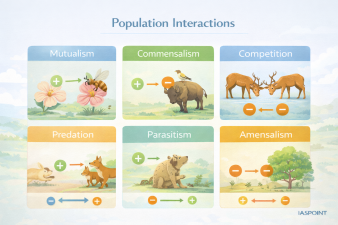
Population interactions refer to the biological relationships between individuals of two different species living in the same community. These interactions are fundamental to the structure of ecosystems, nutrient cycling, and the evolution of species. They are categorized based on whether the interaction is beneficial (+), harmful (-), or neutral (0) to the participants.
Classification of Interactions
| Type of Interaction | Species A | Species B | Nature of Interaction |
| Mutualism | + | + | Both species benefit from the relationship. |
| Commensalism | + | 0 | One benefits, the other is unaffected. |
| Amensalism | – | 0 | One is harmed, the other is unaffected. |
| Competition | – | – | Both species are negatively affected. |
| Predation | + | – | One benefits (predator), one is harmed (prey). |
| Parasitism | + | – | One benefits (parasite), one is harmed (host). |
Beneficial Interactions (Positive)
Mutualism (+/+)
This is an obligatory or facultative relationship where both parties derive a survival advantage.
- Pollination: Insects (bees, butterflies) get nectar while plants achieve cross-pollination.
- Lichens: A symbiotic association between an Alga (provides food) and a Fungus (provides shelter and minerals).
- Mycorrhizae: Interaction between fungi and roots of higher plants. Fungi help in phosphorus absorption, and plants provide energy-yielding carbohydrates.
- Corals: The relationship between coral polyps and Zooxanthellae algae.
Commensalism (+/0)
One species benefits while the other remains neutral, neither helped nor hindered.
- Epiphytes: Plants like Orchids growing on a tree branch for light, without taking nutrients from the tree.
- Barnacles on Whales: Barnacles gain transport to nutrient-rich waters; the whale is unaffected.
- Cattle Egrets and Cattle: Egrets forage near cattle to catch insects stirred up by the grazing animals.
Detrimental Interactions (Negative)
Competition (-/-)
Occurs when two or more species strive for the same limited resource (food, light, space).
- Gause’s Competitive Exclusion Principle: Two species competing for the exact same resources cannot coexist indefinitely; the inferior competitor will be eliminated.
- Resource Partitioning: To avoid competition, species may evolve different feeding times or distinct foraging areas (e.g., different species of warblers on the same tree).
Predation (+/-)
A predator kills and consumes the prey. It acts as a “conduit” for energy transfer across trophic levels.
- Ecological Role: Predators keep prey populations under control (e.g., Starfish Pisaster in rocky intertidal communities maintains species diversity by eating dominant competitors).
- Defense Mechanisms:
- Camouflage: Insects and frogs blending with surroundings.
- Chemical Defense: The Monarch Butterfly is distasteful to predators due to chemicals acquired during its caterpillar stage.
- Morphological Defense: Thorns in Acacia and Cactus.
Parasitism (+/-)
The parasite derives nutrition from the host, often weakening but not immediately killing it.
- Ectoparasites: Live on the external surface (e.g., Lice on humans, Ticks on dogs, Cuscuta on hedge plants).
- Endoparasites: Live inside the host’s body (e.g., Tapeworms, Liver fluke).
- Brood Parasitism: A unique interaction where a bird lays eggs in the nest of another bird. Example: The Cuckoo (Koel) lays eggs in the Crow’s nest.
Amensalism (-/0)
One species is inhibited or harmed, while the other is unaffected.
- Allelopathy: Some plants secrete chemicals that inhibit the growth of neighboring plants (e.g., Black Walnut tree).
- Antibiosis: The fungus Penicillium produces penicillin which inhibits the growth of bacteria, though the fungus itself gains no direct benefit from the death of the bacteria.
UPSC Prelims Specific Trivia
- Protocooperation: A non-obligatory mutualism where both benefit but can survive apart (e.g., Sea anemone on the shell of a hermit crab).
- Niche Overlap: High niche overlap leads to intense competition, whereas low overlap allows coexistence.
- Keystone Species: Often predators (like the Tiger or Sea Otter) that play a disproportionately large role in maintaining the structure of an ecological community.
- Euryphagous vs. Stenophagous: Predators that eat a wide variety of prey vs. those that specialize in only one type.