
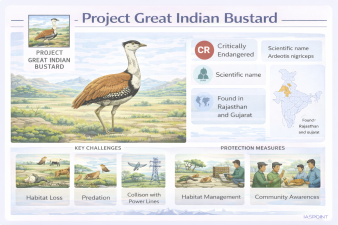
The Great Indian Bustard (Ardeotis nigriceps), one of the heaviest flying birds in the world, is the flagship species of India’s grassland ecosystems. Once a contender for the title of National Bird of India, it is now on the brink of extinction. Project Great Indian Bustard represents the intensive multi-agency effort to prevent its disappearance.
I. Profile of the Great Indian Bustard (GIB)
The GIB is an “umbrella species” for the grassland ecosystem; protecting it ensures the conservation of several other species like the Blackbuck, Chinkara, and Indian Fox.
Physical and Biological Features
- Appearance: Large, ostrich-like bird with a horizontal body and long bare legs. It stands about 1 meter tall.
- Sexual Dimorphism: Males are larger and possess a gular pouch used to produce a resonant “booming” mating call.
- Reproduction: Extremely low reproductive rate; females typically lay only one egg per year directly on the ground.
- Diet: Omnivorous; feeds on grass seeds, insects (grasshoppers, beetles), rodents, and reptiles. It is often called the “Friend of the Farmer” for controlling crop pests.
Conservation Status & Legal Framework
| Category | Status/Act |
| IUCN Red List | Critically Endangered |
| Wildlife Protection Act (1972) | Schedule I (Highest protection) |
| CITES | Appendix I |
| CMS (Bonn Convention) | Appendix I (Included at COP13, Gandhinagar 2020) |
| Current Population | Estimated <150 individuals globally |
II. Distribution and Habitat
Historically, the GIB ranged across 11 states in India and parts of Pakistan. Today, its distribution is severely fragmented.
- Primary Stronghold: Thar Desert, Rajasthan (holds ~90% of the population).
- Other Residues: Small, non-viable populations in Gujarat, Maharashtra, Karnataka, and Andhra Pradesh.
- Key Protected Areas:
- Rajasthan: Desert National Park (Jaisalmer).
- Gujarat: Kutch Bustard Sanctuary (Lala-Parjan).
- Maharashtra: Great Indian Bustard Sanctuary (Nannaj, Solapur).
- Andhra Pradesh: Rollapadu Wildlife Sanctuary.
III. Project Great Indian Bustard: Key Initiatives
Launched by the Government of Rajasthan on World Environment Day (2013), this was the first state-led initiative specifically for the species. It has since evolved into a national effort coordinated with the Wildlife Institute of India (WII) and MoEFCC.
1. Conservation Breeding Program (CBP)
This is the “Insurance Population” strategy. Eggs are collected from the wild, incubated, and hatched in controlled environments.
- Breeding Centres: Established at Sam (Sudasari) and Ramdevra (Jaisalmer).
- Recent Milestone (2026): Successful birth of a chick using Artificial Insemination (AI) at the Ramdevra centre, a global first for this species.
2. Habitat Improvement and Fencing
- Creation of “Closed Areas” where livestock grazing and human interference are prohibited during the breeding season.
- Removal of invasive species like Prosopis juliflora to restore native grasslands.
3. Species Recovery Programme
The GIB is one of the species under the Integrated Development of Wildlife Habitats (IDWH) scheme of the Ministry of Environment, Forest and Climate Change.
IV. Critical Threats and Modern Challenges
The decline of the GIB is attributed to several anthropogenic and environmental factors.
- Power Line Collisions: Due to poor frontal vision and heavy weight, the birds cannot maneuver quickly to avoid overhead transmission lines. This is currently the leading cause of adult mortality.
- Habitat Loss: Conversion of “wastelands” (grasslands) into agricultural lands, solar parks, and wind farms.
- Predation: Stray dogs and crows frequently destroy eggs laid on the ground.
- Infrastructure: Fragmentation of habitat by roads and high-tension wires.
V. Judiciary and the “Right Against Climate Change”
The Supreme Court of India has played a pivotal role in GIB conservation through the case M.K. Ranjitsinh & Ors. v. Union of India.
The 2024-2025 Landmark Rulings
- Undergrounding vs. Renewables: The Court initially ordered the undergrounding of all power lines. However, in March 2024, it modified this to balance conservation with India’s green energy goals.
- Revised Priority Areas: The Court delineated specific regions where overhead lines are strictly prohibited and established an expert committee to oversee the transition.
- Constitutional Link: In a historic observation, the Court linked the protection of the GIB to the “Right against the adverse effects of climate change,” framing it as an extension of Article 21 (Right to Life) and Article 14 (Equality).
VI. Fact Sheet for UPSC Prelims
- Mascot: “Gibi” was the official mascot for CMS COP13 held in India.
- Indicator Species: The GIB is a “bio-indicator” of the health of the grassland ecology.
- State Bird: It is the official State Bird of Rajasthan.
- Names: Locally known as Godawan (Rajasthan), Maldhok (Maharashtra), and Sohan Chidiya.
- Global Population: Almost entirely restricted to India; a few individuals may cross into Pakistan (Cholistan desert), where they face high hunting pressure.