

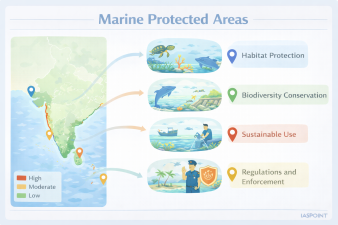
Marine Protected Areas (MPAs) are oceanic or coastal regions designated to protect essential ecological processes, preserve biodiversity, and manage marine resources sustainably. In India, MPAs are primarily notified under the Wildlife (Protection) Act, 1972 (WPA), which provides for four categories: National Parks, Sanctuaries, Conservation Reserves, and Community Reserves.
- Legal Authority: MPAs are governed by the Ministry of Environment, Forest and Climate Change (MoEFCC).
- Coastal Regulation Zone (CRZ): MPAs usually fall under CRZ-IA (Ecologically Sensitive Areas), where developmental activities are strictly prohibited to maintain the integrity of the marine habitat.
- Jurisdiction: Indian MPAs extend from the intertidal zones into the Territorial Waters (up to 12 nautical miles from the baseline).
Current Statistics and Distribution
As of early 2026, India maintains a network of 31 major Marine Protected Areas located primarily along the coast and in island territories. These sites occupy approximately 4% of the total area of all Protected Areas in India.
| Region | Prominent MPAs | Key Features |
| Gujarat | Marine National Park & Sanctuary (Gulf of Kutch) | First Marine National Park in India; home to 42 islands and rich coral reefs. |
| Tamil Nadu | Gulf of Mannar Marine National Park | UNESCO Biosphere Reserve; world-renowned for Dugongs and Pearl Oysters. |
| Odisha | Gahirmatha Marine Sanctuary | World’s largest rookery for Olive Ridley Turtles; strict fishing bans during nesting. |
| Maharashtra | Malvan Marine Sanctuary | Features the historic Sindhudurg fort; rich in sea anemones and mollusks. |
| Andaman & Nicobar | Mahatma Gandhi Marine National Park | Known for its labyrinthine coral reefs and tropical underwater visibility. |
| Lakshadweep | Pitti Bird Sanctuary | A critical pelagic bird nesting site on an uninhabited island. |
Major Categories of MPAs
MPAs in India are categorized based on their management objectives and the level of protection afforded to the species within.
- Marine National Parks: Highest level of protection; no extraction of resources is permitted. (e.g., Rani Jhansi Marine National Park).
- Marine Sanctuaries: Protect specific species or habitats; some regulated activities may be allowed (e.g., Gahirmatha).
- Biosphere Reserves (Marine): Larger areas that include MPAs as “core zones” while allowing sustainable research and tourism in buffer zones (e.g., Gulf of Mannar).
- Marine Biodiversity Heritage Sites: Localized sites recognized for unique ecological or cultural value (e.g., Ameenpur Lake – inland but connected to aquatic biodiversity).
2025-26 Policy Updates: Sustainable Harnessing of Fisheries Rules
In late 2025, the Government notified the Sustainable Harnessing of Fisheries in the Exclusive Economic Zone (EEZ) Rules, 2025, which directly impacts MPA management:
- Prohibited Methods: Strictly bans LED light fishing, pair trawling, and bull trawling in the EEZ to protect the benthic (bottom) marine ecosystem.
- Fisheries Management Plans (FMPs): Introduced to restore declining fish stocks near MPAs.
- Catch Reporting: Mandatory reporting of catches within the EEZ to prevent overexploitation of species migrating in and out of MPAs.
Flagship Species for UPSC Prelims
Aspirants should focus on the following “Flagship Species” associated with Indian MPAs:
- Dugong (Sea Cow): Found in Gulf of Mannar and Palk Bay. Listed under Schedule I of WPA.
- Olive Ridley Turtle: Notable for “Arribada” (mass nesting) on Odisha’s coast.
- Whale Shark: Frequent visitor to the shores of Gujarat (Saurashtra coast).
- Giant Clam: Found in the coral reefs of Andaman and Nicobar Islands.
Challenges in MPA Management
Despite the legal framework, Indian MPAs face significant conservation hurdles:
- Climate Change: Ocean acidification and rising Sea Surface Temperatures (SST) lead to widespread Coral Bleaching.
- Microplastics: Emerging threat to the marine food chain, particularly in sites near industrial hubs like the Gulf of Kutch.
- Ghost Nets: Discarded fishing gear that continues to trap marine mammals and turtles within protected zones.
- Inter-departmental Conflict: Overlap between the Ministry of Fisheries (focusing on harvest) and MoEFCC (focusing on conservation) often complicates enforcement.