

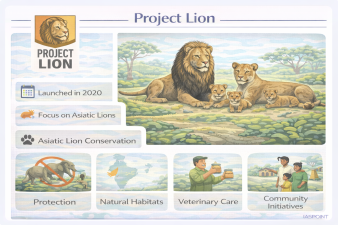
Project Lion was announced by the Prime Minister on August 15, 2020, as a holistic initiative for the conservation of the Asiatic Lion (Panthera leo leo). Managed by the Ministry of Environment, Forest and Climate Change (MoEFCC), it is modeled after the successful Project Tiger. The project emphasizes “landscape ecology-based conservation,” focusing on the entire Gir landscape and its satellite populations across Gujarat to ensure the species’ long-term survival.
Key Objectives and Strategy
The project moves beyond simple protection to a more integrated biological and social management system.
- Habitat Improvement: Focuses on restoring the prey base (ungulates like Chital and Sambar) and managing invasive species like Prosopis juliflora.
- Disease Management: Establishing a “Global Hub for Big Cat Disease Diagnostics” in Gujarat to prevent mass mortality events, such as the 2018 Canine Distemper Virus (CDV) outbreak.
- Modern Monitoring: Deployment of satellite telemetry, radio-collaring, and a Hi-Tech Monitoring Unit at Sasan-Gir for real-time tracking.
- Community Engagement: Involving “Vanya Prani Mitras” (local volunteers) to reduce human-lion conflict and promoting eco-tourism as a livelihood.
Asiatic Lion: 2025 Census and Facts
The 2025 lion census revealed significant growth and a geographic shift in the lion population.
| Parameter | Data / Status |
| Current Population (2025) | 891 (Up from 674 in 2020) |
| IUCN Red List Status | Endangered (Upgraded from Critically Endangered in 2008) |
| Legal Protection | Schedule I of Wildlife (Protection) Act, 1972 |
| Geographic Range | ~35,000 sq. km (Greater Gir Landscape) |
| Distribution Trend | Nearly 55% of lions now live outside protected areas. |
Distribution and Potential Second Homes
While the Gir National Park is the core, the population has expanded into nine satellite regions across districts like Amreli, Bhavnagar, and Gir Somnath.
- Barda Wildlife Sanctuary: Identified and developed as a “second home” within Gujarat to house a separate population, reducing the risk of localized extinction from epidemics.
- Translocation Debate: While Kuno National Park in Madhya Pradesh was originally suggested by the Supreme Court (2013) for lion translocation, current efforts under Project Lion focus heavily on the “Greater Gir Landscape” and Barda.
- Satellite Populations: Regions such as Savarkundla-Liliya and the coastal belts of Saurashtra are now permanent habitats for “satellite prides” that live in human-dominated landscapes.
Distinguishing Features: Asiatic vs. African Lions
For Prelims, it is crucial to distinguish between the two subspecies.
- Morphology: Asiatic lions are generally smaller than African lions.
- The Belly Fold: A unique longitudinal fold of skin running along the belly is seen in Asiatic lions but is rare in African lions.
- The Mane: Male Asiatic lions have a shorter mane than their African counterparts, which allows their ears to remain visible.
- Social Structure: Asiatic lion prides are usually smaller, and males tend to associate with females only for mating or large kills.
Conservation Infrastructure
The project has institutionalized several breeding and research facilities to maintain genetic health.
- Gene Pool Centers: Established at Rampara, Sakkarbaug, and Satveerada for controlled breeding and genetic studies.
- Veterinary Strengthening: Creation of dedicated hospitals and rapid response teams for injured or diseased lions.
- Conflict Mitigation: Distribution of “Machans” (raised platforms) to farmers and the construction of parapet walls around open wells to prevent accidental drownings.