

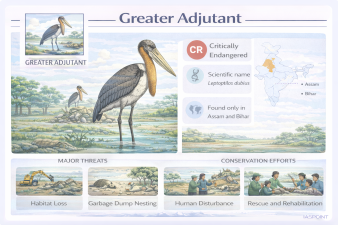
The Greater Adjutant (Leptoptilos dubius) is one of the rarest and most endangered storks in the world. Locally known as Hargila in Assamese (derived from “Hargila” meaning bone-swallower), it is a large scavenger bird that plays a vital role in the ecosystem by disposing of decaying organic matter. Once found across much of South and Southeast Asia, its global population is now restricted to a few isolated pockets.
Physical Characteristics and Behavior
- Size: It is a massive bird, standing about 145–150 cm tall with a wingspan of approximately 250 cm.
- Distinctive Features: It possesses a large, wedge-shaped bill, a bright orange or yellow naked head and neck, and a unique pendulous gular (throat) pouch which is not connected to the digestive tract.
- Diet: Primarily a scavenger; it feeds on carcasses, offal, and fish, but also hunts frogs, reptiles, and large insects.
- Breeding: They are colonial nesters, often building large platform nests in the canopy of tall broad-leaved trees.
Conservation Status and Legal Protection
The Greater Adjutant is a critical subject for UPSC due to its precarious survival status and successful community-led conservation models.
| Framework | Status/Category |
| IUCN Red List | Endangered |
| Wildlife Protection Act, 1972 | Schedule I (Highest Protection) |
| Global Population | Estimated at fewer than 1,200–1,500 individuals |
Distribution and Key Habitats
The species is currently confined to only three known breeding grounds globally, with India hosting the vast majority of the population.
- Assam, India: The Brahmaputra Valley is the primary stronghold, particularly in districts like Kamrup and Morigaon.
- Bihar, India: The floodplains of the Ganges and Kosi rivers (Bhagalpur and Purnia districts) serve as the second-largest breeding colony.
- Cambodia: Small, dwindling populations are found around the Tonle Sap Lake.
The “Hargila Army”: A Model for Conservation
A significant aspect of Greater Adjutant conservation is the Hargila Army, an all-female conservation group in Assam led by biologist Purnima Devi Barman (winner of the Whitley Gold Award and UN Champions of the Earth).
- Social Impact: The movement transformed the bird’s image from a “bad omen” or “dirty scavenger” to a cultural icon and “protector of the village.”
- Methods: Community-led nest monitoring, weaving traditional Assamese textiles with Hargila motifs to generate income, and protecting nesting trees on private lands.
Major Threats to the Species
- Habitat Loss: Felling of nesting trees (like Kadam and Simal) and the drainage of wetlands (beels) which serve as foraging grounds.
- Pollution: Accidental poisoning at garbage dumps where they forage, and the ingestion of plastic waste.
- Electrocution: Collision with high-tension power lines near nesting colonies.
- Urbanization: Encroachment into suburban areas leading to loss of traditional feeding sites.
Comparison with Lesser Adjutant Stork
Aspirants should distinguish between the Greater and Lesser Adjutant to avoid confusion in descriptive questions.
| Feature | Greater Adjutant (L. dubius) | Lesser Adjutant (L. javanicus) |
| Size | Larger (150 cm) | Smaller (120 cm) |
| Neck Pouch | Large pendulous pouch present | No pendulous pouch |
| Bill | Massive, thick, and wedge-shaped | Slightly more slender |
| IUCN Status | Endangered | Vulnerable |
| Range | Restricted (Assam, Bihar, Cambodia) | Widespread across South & SE Asia |
Trivia and Facts for Prelims
- Vulture-like Role: Since vulture populations have declined in India, the Greater Adjutant has taken over a more prominent role as a primary scavenger in its habitats.
- Cultural Significance: In Assamese folklore, the bird was historically viewed with superstition, but it is now integrated into local festivals and handloom designs.
- Nesting Season: Their breeding season coincides with the dry season in Assam (Winter), typically from October to May.
- Artificial Breeding: The Vulture Conservation Breeding Centre (VCBC) and local initiatives in Assam have experimented with artificial platforms to encourage nesting where tall trees are absent.