
The United Nations Environment Programme (UNEP) defines a green economy as one that results in improved human well-being and social equity, while significantly reducing environmental risks and ecological scarcities. In its simplest form, a green economy is low-carbon, resource-efficient, and socially inclusive. Unlike traditional economic models, it internalizes the “externalities” or environmental costs of production and consumption.
Pillars and Objectives
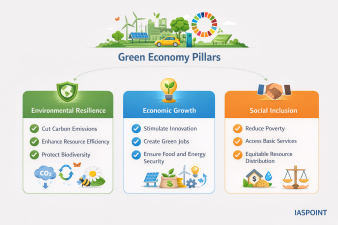
The green economy is built upon three primary pillars that align with the Sustainable Development Goals (SDGs):
- Environmental Resilience: Reducing carbon emissions and pollution, enhancing energy and resource efficiency, and preventing the loss of biodiversity and ecosystem services.
- Economic Growth: Stimulating innovation in clean technology, creating “green jobs,” and ensuring long-term food and energy security.
- Social Inclusion: Ensuring equitable distribution of resources, poverty eradication, and improving access to basic services like clean water and sustainable energy.
Key Strategies and Mechanisms
Transitioning to a green economy requires specific policy interventions and market mechanisms:
Carbon Pricing
This involves putting a price on carbon emissions to encourage industries to reduce their output. It is implemented through:
- Carbon Tax: A direct fee on the carbon content of fossil fuels.
- Emission Trading Systems (ETS): Often called “Cap and Trade,” where a limit is set on emissions, and companies can trade emission permits.
Green Finance
The mobilization of capital for projects that contribute to environmental sustainability.
- Green Bonds: Fixed-income instruments specifically earmarked to raise money for climate and environmental projects.
- Sovereign Green Bonds: Issued by governments; India issued its first Sovereign Green Bond in 2023 to fund green infrastructure.
Circular Economy
A shift from the linear “Take-Make-Dispose” model to a system where products are designed for durability, reuse, and recycling, thereby minimizing waste.
India’s Initiatives toward a Green Economy
India has launched several flagship programs to decouple economic growth from environmental degradation:
| Sector | Initiative | Objective |
| Energy | International Solar Alliance (ISA) | Global platform to promote solar energy consumption. |
| Energy | PM-KUSUM | Solarization of agricultural pumps to reduce diesel dependency. |
| Transport | FAME-II Scheme | Faster Adoption and Manufacturing of Hybrid and Electric Vehicles. |
| Waste | GOBAR-dhan Scheme | Converting cattle dung and solid waste into Bio-CNG and compost. |
| Finance | SEBI Green Bond Framework | Guidelines for issuing and listing green debt securities. |
| Forestry | Green Credit Programme | An incentive-based mechanism for various stakeholders to plant trees. |
Global Frameworks and Indicators
The transition to a green economy is monitored through various international frameworks:
PAGE (Partnership for Action on Green Economy)
A UN mechanism that supports nations in reframing economic policies around sustainability. India is a member and collaborator with PAGE.
Global Green Economy Index (GGEI)
This index measures the green economic performance of various countries based on four dimensions: leadership and climate change, efficiency sectors, markets and investment, and the environment.
Challenges to the Green Economy
- High Initial Capital: Green technologies often require significant upfront investment compared to traditional fossil-fuel-based systems.
- Technological Gap: Many developing nations lack the intellectual property rights or technical expertise to implement advanced green solutions.
- Transition Risks: The potential for “Green Inflation” (rising costs of materials like lithium and copper) and the loss of jobs in traditional sectors like coal mining.
Fact-File for UPSC Prelims
- Rio+20 (2012): This conference formally recognized the “Green Economy in the context of sustainable development and poverty eradication” as a key tool for achieving sustainability.
- Green Jobs: Employment in agriculture, manufacturing, R&D, and service activities that contribute substantially to preserving or restoring environmental quality.
- Natural Capital Accounting: The process of calculating the total stocks and flows of natural resources and services in a given ecosystem or region.
- LiFE (Lifestyle for Environment): A global movement introduced by India at COP26 to promote individual and community action toward mindful and deliberate utilization of resources.