
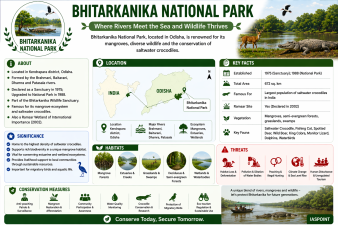
Bhitarkanika National Park is a premier coastal ecosystem located in the Kendrapara district of Odisha. National Park Status: Notified in 1998.
- Ramsar Site: Designated as a Wetland of International Importance in 2002.
- Eco-Sensitive Zone: Surrounded by the Bhitarkanika Wildlife Sanctuary and includes the Gahirmatha Marine Sanctuary on its eastern boundary.
- Geographic Context: Formed by the estuarine delta of the Brahmani, Baitarani, Dhamra, and Pathsala rivers.
Ecological Significance: The Mangrove Kingdom
Bhitarkanika is the second-largest mangrove ecosystem in India after the Sundarbans. It is often cited as being more diverse than the Sundarbans in terms of floral species.
- Floral Diversity: It hosts over 60–70 species of mangroves, including Heritiera fomes (Sundari tree) and Excoecaria agallocha.
- Bio-Shield: The dense mangrove roots act as a natural barrier against cyclones and tsunamis, protecting the inland villages of Odisha.
- Accretion: The park is a classic example of land accretion where the river silt and mangrove roots work together to extend the shoreline.
Flagship Fauna and Wildlife
The park is internationally famous for its successful conservation of crocodilians and marine turtles.
| Species | Significance |
| Saltwater Crocodile | Largest population in India; includes “White Crocodiles” (Leucistic). |
| Olive Ridley Turtle | Gahirmatha beach (part of the ecosystem) is the world’s largest rookery for mass nesting (Arribada). |
| King Cobra | Found in the dense forested patches; Bhitarkanika is a major habitat for these apex predators. |
| Water Monitor Lizard | High density of these large lizards is a key ecological indicator of the park’s health. |
| Avifauna | Significant wintering ground for migratory birds; features a massive heronry at Bagagahana. |
Saltwater Crocodile Conservation Project
Bhitarkanika is the success story of the Saltwater Crocodile Conservation Project, launched in 1975 with support from the UNDP and FAO.
- Breeding Success: From only 96 crocodiles in the mid-70s, the population has grown to over 1,800 in 2024-2026.
- The “Kalia” Legend: The park is famous for exceptionally large crocodiles, with some males exceeding 20 feet in length.
Gahirmatha Marine Sanctuary
Although administratively linked, Gahirmatha is the marine component of the Bhitarkanika ecosystem.
- Location: Extends from the Dhamra River mouth to the Mahanadi River mouth.
- Arribada: Between January and March, hundreds of thousands of Olive Ridley turtles arrive to lay eggs.
- Protection: The Indian Coast Guard executes “Operation Olivia” every year to protect these turtles from illegal trawling.
Key Trivia for UPSC Prelims
- The “Sundari” Tree: Unlike the Sundarbans where Heritiera fomes is facing high salinity stress, it thrives in the relatively fresher water zones of Bhitarkanika.
- Bagagahana Heronry: One of the largest heronries in Asia, attracting species like Open-billed Storks, Grey Herons, and Purple Herons.
- White Crocodiles: Bhitarkanika is the only place in India where the rare partial-albino or leucistic saltwater crocodiles are found in the wild.
- Cyclonic Protection: During Cyclone Amphan (2020) and subsequent storms, the mangroves significantly reduced the wind velocity and tidal surge impact.
Threats and Management
- Salinity Changes: Changes in the freshwater inflow from the Brahmani and Baitarani rivers (due to upstream dams) can alter the mangrove composition.
- Siltation: Heavy siltation in the river mouths can obstruct the movement of aquatic species.
- Human-Crocodile Conflict: The rising crocodile population has led to increased straying into nearby human habitations, necessitating community awareness programs.