

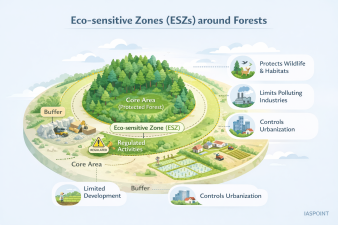
Eco-Sensitive Zones (ESZs), also known as Ecologically Fragile Areas (EFAs), are areas notified by the Ministry of Environment, Forest and Climate Change (MoEFCC) around Protected Areas, National Parks, and Wildlife Sanctuaries. They function as “shock absorbers” or “transition zones” between areas of high protection and areas involving intensive human activity.
Legal Status and Regulatory Framework
The concept of ESZs is rooted in the National Wildlife Action Plan (2002–2016), which stipulated that land within 10 km of the boundaries of national parks and sanctuaries should be notified as eco-fragile zones.
- Statutory Provision: ESZs are notified under the Environment (Protection) Act, 1986. Interestingly, the word “Eco-Sensitive Zone” is not explicitly mentioned in the Act; the government uses Section 3(2)(v) of the Act to restrict locations of industries and operations.
- Extent: The general principle is a 10 km radius around a protected area. However, if the sensitive corridor for wildlife exceeds 10 km, the width can be extended beyond this limit (e.g., the ESZ for Bandipur Tiger Reserve).
- Supreme Court Mandate (2022/2023): In 2022, the SC mandated a minimum 1 km ESZ for all protected areas. In 2023, the court clarified that this 1 km rule would not apply to ESZs that are already notified or to sanctuary areas that overlap with international borders.
Categorization of Activities in ESZs
Activities within an ESZ are not completely prohibited but are regulated based on their impact on the environment.
| Prohibited Activities | Regulated Activities | Permitted Activities |
| Commercial mining and stone quarrying. | Felling of trees (with permission). | Ongoing agricultural/horticultural practices by locals. |
| Setting up of polluting industries. | Construction of hotels and resorts. | Rainwater harvesting and organic farming. |
| Major hydroelectric projects. | Drastic change in land use. | Use of renewable energy sources. |
| Commercial use of firewood. | Widening of roads. | Green technology adoption. |
Objectives and Significance
- Buffer Strategy: ESZs prevent the “island” effect where protected areas become isolated due to surrounding urban or industrial growth.
- Mitigating Man-Animal Conflict: By regulating human activity at the fringes, ESZs provide a safe passage (corridors) for wildlife, reducing crop raiding and attacks.
- In-situ Conservation: They protect the underlying ecological processes and genetic diversity of the region.
- Community Engagement: ESZs aim to move from a “command and control” approach to a participatory one, ensuring local communities benefit from conservation.
Case Studies and Environmental Committees
The delimitation of ESZs has often been a point of contention between development and conservation.
- Western Ghats Controversy: The Madhav Gadgil Panel (Western Ghats Ecology Expert Panel) recommended that the entire Western Ghats be declared an ESZ. The subsequent Kasturirangan Committee proposed a more moderate approach, suggesting that only 37% of the Western Ghats be designated as ecologically sensitive.
- Sanjay Gandhi National Park (Mumbai): An example where the ESZ is highly restricted (down to 100 meters in some parts) due to the surrounding dense urban landscape.
- Pulicat Lake (Tamil Nadu/Andhra Pradesh): ESZ notifications here are critical for protecting migratory bird flyways.
Technical Trivia for UPSC Prelims
- Zonal Master Plan (ZMP): Once an ESZ is notified, the State Government must prepare a ZMP within two years, which details the land-use patterns and conservation strategies.
- ESZ Monitoring Committee: Usually chaired by the District Collector, this committee is responsible for ensuring compliance with the guidelines.
- Blue Flag Beaches: While ESZs apply to forests/wildlife areas, coastal regions are similarly protected under CRZ (Coastal Regulation Zone) notifications.
- Smallest ESZ: Some urban wildlife sanctuaries have ESZs as narrow as 0 to 100 meters due to existing permanent structures.
Institutional Roles
| Entity | Role in ESZ |
| MoEFCC | Final authority for notifying ESZs under the Environment Protection Act. |
| State Government | Responsible for proposing ESZ boundaries and drafting the Zonal Master Plan. |
| National Board for Wildlife (NBWL) | Provides policy framework and clearance for certain activities within ESZs. |