

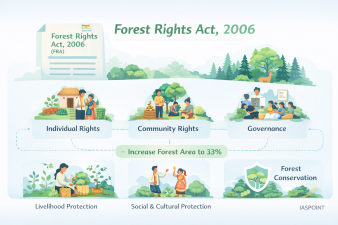
The Scheduled Tribes and Other Traditional Forest Dwellers (Recognition of Forest Rights) Act, 2006—commonly known as the Forest Rights Act (FRA)—was enacted to redress the “historical injustice” committed against forest-dwelling communities. For decades, state forest laws did not recognize the pre-existing rights of these communities, leading to their categorization as “encroachers” on their own ancestral lands.
Eligibility Criteria for Claiming Rights
The Act identifies two specific categories of claimants who must be residing in and depending on the forest land for bona fide livelihood needs:
- Scheduled Tribes (FDST): Members or communities of the Scheduled Tribes who primarily reside in and who depend on the forests or forest lands for bona fide livelihood needs.
- Other Traditional Forest Dwellers (OTFD): Any member or community who can prove they have resided in and depended on the forest land for at least three generations (75 years) prior to December 13, 2005.
Types of Rights Recognized under FRA
The Act categorizes rights into four distinct types to ensure a 360-degree protection of forest dwellers.
Title Rights (Ownership)
Ownership to land that is being cultivated by tribals or forest dwellers as of December 13, 2005, subject to a maximum of 4 hectares. No new lands are granted; only land already under occupation is recognized.
Use Rights
Rights to minor forest produce (MFP), grazing areas, and pastoralist routes. This includes the right to collect, use, and dispose of minor forest produce which has been traditionally collected within or outside village boundaries.
Forest Management Rights
The right to protect, regenerate, conserve, or manage any community forest resource which they have been traditionally protecting and conserving for sustainable use.
Relief and Development Rights
Right to rehabilitation in case of illegal eviction or forced displacement and to basic amenities, subject to restrictions for facilities like schools, dispensaries, and roads.
The Three-Tier Process of Recognition
The FRA is unique because the process of recognizing rights begins at the grassroots level, ensuring democratic decentralization.
- Gram Sabha: The Gram Sabha (village assembly) is the authority to initiate the process for determining the nature and extent of Individual Forest Rights (IFR) or Community Forest Rights (CFR).
- Sub-Divisional Level Committee (SDLC): Functions as a body to examine the resolution passed by the Gram Sabha and prepare the record of forest rights.
- District Level Committee (DLC): The final authority to approve the record of forest rights and grant the titles. It consists of officers from Revenue, Forest, and Tribal Affairs departments and three members of the local Panchayati Raj institutions.
Key Provisions and Definitions
Minor Forest Produce (MFP)
The Act defines MFP to include all non-timber forest produce of plant origin, including bamboo, brushwood, stumps, cane, tussar, cocoons, honey, wax, lac, tendu or kendu leaves, medicinal plants and herbs, roots, and tubers.
Critical Wildlife Habitat (CWH)
The FRA provides for the notification of “Critical Wildlife Habitats” within National Parks and Sanctuaries. These are areas required to be kept “inviolate” for wildlife conservation. However, the Act mandates that no forest dweller can be resettled from these areas until their forest rights are fully recognized and the process of resettlement is complete with their free informed consent.
Critical Facts for UPSC Prelims
| Feature | Description |
|---|---|
| Nodal Ministry | Ministry of Tribal Affairs (MoTA), not the Ministry of Environment. |
| Cut-off Date | December 13, 2005 (Rights must exist prior to this date). |
| Max Land Limit | 4 hectares per family/individual. |
| Alienation | The land is heritable but not alienable or transferable. |
| Gram Sabha Composition | Must include at least one-third women members in the Quorum. |
Major Challenges in Implementation
- High Rejection Rates: A significant percentage of individual and community claims are rejected by the District Level Committees without providing sufficient reasons or opportunities for appeal.
- Conflict with Forest Department: Constant friction between the Tribal Affairs Ministry and the Environment Ministry over the control of forest land and the definition of “community forest resources.”
- Lack of Awareness: Many forest-dwelling communities remain unaware of the technicalities involved in filing claims and the types of evidence required.
- Digital Mapping Issues: Errors in GPS surveys and satellite imagery interpretation often lead to the rejection of claims based on “lack of evidence” of occupation prior to 2005.
Trivia and Recent Developments
- The Niyamgiri Case: In a landmark 2013 judgment (Vedanta vs. Union of India), the Supreme Court upheld the power of the Gram Sabha to decide whether mining in the Niyamgiri hills would affect the religious and cultural rights of the Dongria Kondh tribe.
- Bamboo Legalization: In 2011, the Ministry of Environment formally reclassified bamboo as a “Minor Forest Produce” to align with the FRA, ending decades of state monopoly over its trade.
- Community Forest Resource (CFR) Rights: Odisha and Chhattisgarh have been frontrunners in recognizing CFR rights, allowing villages to legally manage thousands of hectares of forest land.