

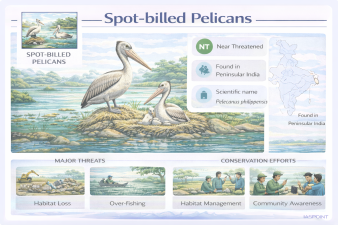
The Spot-billed Pelican (Pelecanus philippensis), also known as the Grey Pelican, is a large water bird belonging to the family Pelecanidae. It is one of the few pelican species that breeds in South Asia. Unlike the migratory Great White Pelican, the Spot-billed Pelican is primarily a resident or local migrant within the Indian subcontinent.
Physical Characteristics and Identification
- Distinctive Features: It is characterized by a large, heavy bill with a series of dark spots on the side of the upper mandible. It has a greyish-white plumage and a brownish-grey crest of feathers on the hindneck.
- Size: It is a medium-sized pelican, typically measuring 125–152 cm in length. It is smaller than the Great White Pelican.
- Pouch: It possesses a large throat pouch (gular pouch) used for scooping up fish.
- Flight: They are powerful fliers and often fly in a ‘V’ formation or a long line to reduce wind resistance.
Conservation Status and Threats
The species has seen a fluctuating population trend, making it a significant indicator of wetland health.
| Framework | Status/Category |
| IUCN Red List | Near Threatened |
| Wildlife Protection Act, 1972 | Schedule I |
| CITES | Not listed in Appendices (but protected nationally) |
Breeding and Habitat
Spot-billed Pelicans are colonial nesters, often nesting in “pelicanries” alongside other water birds like Painted Storks.
- Preferred Habitat: They inhabit a variety of deep and shallow wetlands, including freshwater lakes, brackish lagoons, marshes, and occasionally coastal areas.
- Nesting: They build large platform nests on trees (frequently Prosopis juliflora or Acacia species) rather than on the ground.
- Diet: Exclusively piscivorous (fish-eating). They often hunt cooperatively by swimming in a circle to corral fish into shallow water.
Key Locations and Pelicanries in India
South India, particularly Andhra Pradesh and Tamil Nadu, hosts the most significant breeding colonies.
- Uppalapadu Bird Sanctuary (Andhra Pradesh): One of the most famous nesting sites where pelicans nest on artificial stands and trees within the village tanks.
- Nelapattu Bird Sanctuary (Andhra Pradesh): Located near Pulicat Lake, it is one of the largest pelicanries in Southeast Asia.
- Kokkare Bellur (Karnataka): A unique site where villagers protect the birds, believing them to be harbingers of good luck and prosperity.
- Vedanthangal Bird Sanctuary (Tamil Nadu): An ancient community-protected wetland that supports a large breeding population.
- Atapaka Bird Sanctuary (Andhra Pradesh): Located on Kolleru Lake, it is a vital site that has recently seen record numbers of nesting pairs.
Major Threats to Survival
- Habitat Degradation: Siltation of wetlands and the conversion of marshes into aquaculture ponds or agricultural land.
- Food Scarcity: Overfishing by humans in large freshwater lakes reduces the prey base for these large birds.
- Tree Felling: Loss of large nesting trees due to urbanization or storm damage (e.g., Cyclones in the Bay of Bengal).
- Nematode Infestations: In recent years (notably 2022-2023), massive die-offs have been recorded in the Telineelapuram area of Andhra Pradesh due to “Infestation of Nematodes” (parasitic worms) transmitted through infected fish.
- Pollution: Pesticide runoff from agricultural fields leads to bioaccumulation and eggshell thinning.
Comparison with Great White Pelican
Distinguishing between the two species is essential for identifying them in the field and in UPSC questions.
| Feature | Spot-billed Pelican | Great White Pelican |
| Origin | Resident/Local Migrant | Long-distance Migrant (from Europe/Asia) |
| Bill | Spots on the upper mandible | No spots; yellow/pinkish bill |
| Plumage | Dull greyish-white | Bright snowy white (pinkish in breeding) |
| Nesting | On trees (Arboreal) | On the ground |
Trivia for UPSC Prelims
- Cooperative Feeding: They are known to synchronize their movements with other water birds to maximize fishing efficiency.
- Village Conservation: The “Kokkare Bellur” model is often cited as a successful example of “Community Conserved Areas” (CCAs) where local people provide land and protection for the birds.
- Indicator of Water Quality: Their presence in large numbers indicates a healthy, fish-rich aquatic ecosystem.
- Gular Fluttering: Like other pelicans, they flap their throat pouch to cool down, a process known as gular fluttering.