
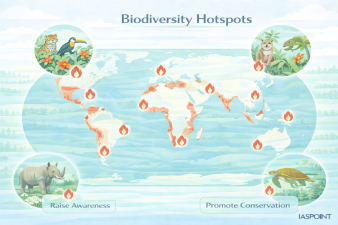
A Biodiversity Hotspot is a biogeographic region with significant levels of biodiversity that is under threat from human habitation. The concept was first introduced by British ecologist Norman Myers in 1988 to identify priority areas for conservation. These regions are essentially the Earth’s most biologically rich—yet threatened—terrestrial areas.
Criteria for Qualification
To qualify as a biodiversity hotspot, according to Conservation International, a region must meet two strict criteria:
- Species Endemism: It must contain at least 1,500 species of vascular plants (≈ 0.5% of the world’s total) as endemics. Endemic species are those found nowhere else on Earth.
- Degree of Threat: It must have lost at least 70% of its original native habitat. In other words, it must have 30% or less of its original natural vegetation remaining.
Global Status and Significance
- There are currently 36 recognized biodiversity hotspots in the world.
- While they cover only about 2.5% of Earth’s land surface, they support more than 50% of the world’s plant species and nearly 43% of bird, mammal, reptile, and amphibian species as endemics.
- The Hottest Hotspots are identified based on five factors: number of endemics, endemic species/area ratio, endangered species, and degree of habitat loss. Examples include Madagascar, the Philippines, and the Western Ghats/Sri Lanka.
Biodiversity Hotspots in India
India is home to four major biodiversity hotspots, which overlap with its neighboring countries.
| Hotspot Name | Geographical Coverage in India | Key Flora/Fauna |
| Himalayas | Entire Indian Himalayan region (North-East India, Bhutan, Nepal). | Snow Leopard, Red Panda, Himalayan Tahr. |
| Indo-Burma | North-Eastern India (excluding Assam and Gangetic plains), Myanmar, Thailand, Vietnam. | Ginger Lilies, Gibbons, Grey-crowned Crocias. |
| Western Ghats & Sri Lanka | Sahyadri Hills, Malabar Coast (Kerala, Karnataka, Maharashtra, TN). | Lion-tailed Macaque, Nilgiri Tahr, Purple Frog. |
| Sundaland | Nicobar Islands (extending to Indonesia, Malaysia, Singapore). | Mangroves, Orangutans (in SE Asia), Nicobar Megapode. |
Key Features of Indian Hotspots
1. The Himalayas
- Includes the highest mountains in the world.
- Features a massive altitudinal gradient, ranging from alluvial grasslands to high alpine meadows.
- Home to iconic endangered species like the One-horned Rhinoceros and the Wild Asian Water Buffalo.
2. Western Ghats
- Recognized as a UNESCO World Heritage Site.
- Characterized by high levels of endemism; nearly 77% of amphibians and 62% of reptiles found here are endemic.
- Acts as a “monsoon gateway” for the Indian peninsula.
3. Indo-Burma
- One of the most threatened hotspots due to high population density and rapid land-use change.
- Known for the discovery of several new mammal species in recent decades (e.g., Saola, Large-antlered Muntjac).
4. Sundaland
- In India, it specifically covers the Nicobar Islands.
- Rich in marine biodiversity and coastal mangroves.
- The region is part of the Indo-Malayan archipelago.
Threats to Biodiversity Hotspots
- Habitat Fragmentation: Breaking large habitats into smaller patches due to infrastructure and agriculture.
- Invasive Species: Non-native species outcompeting endemics (e.g., Lantana camara in Indian forests).
- Overexploitation: Illegal wildlife trade and unsustainable logging.
- Climate Change: Shifting temperature regimes affecting specialized niche species in high-altitude hotspots like the Himalayas.
Related Conservation Concepts
- Hope Spots: Areas in the ocean that are critical to the health of the ocean (e.g., Andaman and Nicobar Islands, Lakshadweep).
- Hottest Hotspots: A sub-set of hotspots that are most at risk based on the density of endemic species.
- Biodiversity Coldspots: Areas with low species richness but high evolutionary uniqueness or rare species.
UPSC Prelims Trivia: The “36th” Hotspot
The North American Coastal Plain was designated as the world’s 36th biodiversity hotspot in 2016. It met the criteria due to its high level of endemic vascular plants and significant habitat loss from urban sprawl and agriculture. In India, the Western Ghats often ranks among the top 8 “Hottest Hotspots” in the world due to its immense biological pressure and unique species.
Last Modified: April 18, 2026