

Sustainable development is guided by several core principles that bridge the gap between environmental conservation and socioeconomic advancement. These principles serve as the legal and ethical basis for international environmental law and national policymaking.
Core Ethical and Legal Principles
Inter-generational Equity
This principle dictates that the current generation holds the Earth in trust for future generations. It mandates that we hand over the planet in no worse a condition than we received it, ensuring that future inhabitants have equal access to natural resources and a healthy environment.
Intra-generational Equity
While inter-generational equity looks forward in time, intra-generational equity looks across the present population. It focuses on reducing the gap between the rich and the poor, ensuring that development benefits all sections of society, particularly the marginalized, within the current timeframe.
Precautionary Principle
Adopted at the 1992 Rio Earth Summit, this principle states that where there are threats of serious or irreversible damage, lack of full scientific certainty shall not be used as a reason for postponing cost-effective measures to prevent environmental degradation. It shifts the burden of proof to those proposing an activity that could be harmful.
Polluter Pays Principle (PPP)
The Polluter Pays Principle implies that the absolute liability for harming the environment rests with the polluter. It ensures that the costs of pollution control, cleanup, and restoration are borne by the party responsible for the damage, rather than the taxpayer or society at large.
Principles of Global Cooperation
Common But Differentiated Responsibilities (CBDR)
Recognized under the UNFCCC, this principle acknowledges that while all nations are responsible for addressing global environmental issues like climate change, they are not equally responsible. Developed nations, having contributed more to historical emissions and possessing greater financial and technical resources, must take the lead.
Principle of Integration
This requires that environmental protection be an integral part of the development process and cannot be considered in isolation. Economic, social, and environmental factors must be integrated at all levels of decision-making.
Public Participation and Access to Information
Sustainable development cannot be achieved without the involvement of stakeholders. This principle emphasizes that individuals should have access to information concerning the environment held by public authorities and the opportunity to participate in decision-making processes.
Economic and Management Principles
Carrying Capacity
Sustainable development is limited by the carrying capacity of the ecosystem. This principle asserts that the rate of resource extraction should not exceed the rate of resource regeneration, and the rate of waste generation should not exceed the assimilative capacity of the environment.
The Circular Economy Model
Moving away from the “take-make-dispose” linear model, the circular principle promotes the 3Rs: Reduce, Reuse, and Recycle. It aims to close the loop of product lifecycles through better design and resource efficiency.
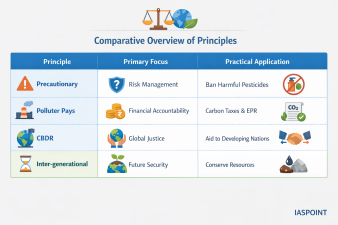
Comparative Overview of Principles
| Principle | Primary Focus | Practical Application |
|---|---|---|
| Precautionary | Risk Management | Banning harmful pesticides before definitive proof of total species collapse. |
| Polluter Pays | Financial Accountability | Carbon taxes, Green Cess, and Extended Producer Responsibility (EPR). |
| CBDR | Global Justice | Financial transfers from developed to developing nations for climate mitigation. |
| Inter-generational | Future Security | Conservation of non-renewable resources and debt sustainability. |
Trivia for UPSC Prelims
- The Brundtland Commission (1987): Formally titled the World Commission on Environment and Development (WCED), it provided the most widely accepted definition of sustainability.
- The Rio Declaration (1992): Contained 27 principles intended to guide sustainable development around the world.
- Externalities: In economics, the principles of sustainability aim to “internalize the externalities,” meaning the hidden environmental costs of production are reflected in the market price of goods.
- Green Accounting: India is working toward incorporating environmental costs into national accounts, a process supported by the 13th Finance Commission.