
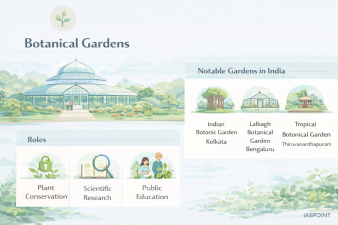
Botanical gardens are ex-situ (off-site) conservation centers where plants are grown for scientific research, conservation, display, and education. Unlike Sanctuaries or National Parks (in-situ), these are man-made environments designed to preserve genetic diversity.
- Primary Functions: Conservation of rare and endangered species, seed banking, taxonomic studies, and acting as centers for “reintroduction” of species into the wild.
- Legal Framework: In India, many botanical gardens are managed by the Botanical Survey of India (BSI) under the Ministry of Environment, Forest and Climate Change (MoEFCC).
- Lead Garden Scheme: A MoEFCC scheme that provides financial assistance to botanical gardens to improve their infrastructure and conservation capabilities for regional endemic plants.
Major Botanical Gardens in India
India hosts several historic and scientifically significant gardens that serve as repositories for both indigenous and exotic flora.
| Name of Garden | Location | Notable Features / Trivia |
| Acharya Jagadish Chandra Bose Indian Botanic Garden | Howrah, West Bengal | Home to the Great Banyan Tree, which has the largest canopy in the world. Established in 1787. |
| National Botanical Research Institute (NBRI) | Lucknow, Uttar Pradesh | A premier CSIR lab. Famous for its germplasm collections of Bougainvillea and Gladiolus. |
| Government Botanical Garden | Ootacamund (Ooty), TN | Features a 20-million-year-old fossilized tree trunk. Known for temperate flora. |
| Lalbagh Botanical Garden | Bengaluru, Karnataka | Commissioned by Hyder Ali. Features the famous Glass House modeled after London’s Crystal Palace. |
| Lloyd’s Botanical Garden | Darjeeling, West Bengal | Specializes in Eastern Himalayan flora, particularly Orchids and Alpine plants. |
| Tropical Botanic Garden and Research Institute (TBGRI) | Thiruvananthapuram, Kerala | Largest conservation center for tropical plants in Asia. Known for “Arogyapacha” (medicinal plant). |
International Frameworks and Organizations
Botanical gardens operate within a global network to ensure the exchange of seeds and conservation data.
Botanic Gardens Conservation International (BGCI)
- The world’s largest plant conservation network.
- Maintains the GlobalTreeSearch (database of all known tree species) and PlantSearch.
Convention on International Trade in Endangered Species (CITES)
- Botanical gardens play a critical role in housing “confiscated” plant specimens that were being illegally traded.
- They assist in the scientific identification of species listed under CITES Appendices.
Arboretum vs. Botanical Garden
While often used interchangeably, there is a technical distinction important for environmental science.
- Botanical Garden: A wide collection of plants including herbs, shrubs, trees, ferns, and even aquatic plants for comprehensive study.
- Arboretum: A specialized botanical garden devoted specifically to the cultivation and study of trees and woody plants.
Key Concepts for UPSC Prelims
- Ex-situ Conservation: Botanical gardens are classic examples, along with Zoo, Gene Banks, and Seed Banks.
- Greenhouses: Controlled environments within gardens used to grow plants that require specific climatic conditions (e.g., tropical plants in temperate regions).
- Seed Banks: Many botanical gardens host seed banks (e.g., the Millennium Seed Bank Partnership) to store seeds at low temperatures to maintain viability for centuries.
- The Great Banyan Tree: Scientifically known as Ficus benghalensis. It lacks a main trunk (the original trunk decayed) and survives on over 3,000 prop roots, covering nearly 4 acres.
- Arid Zone Botanic Garden: Located in Jodhpur, it focuses on the conservation of desert flora (Xerophytes) of the Thar Desert.