
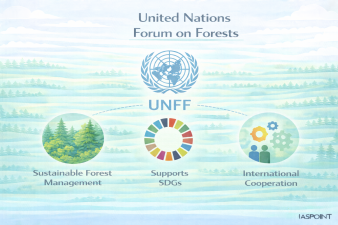
The United Nations Forum on Forests (UNFF) is a high-level intergovernmental policy forum established to promote the management, conservation, and sustainable development of all types of forests. It serves as the central body within the UN system for forest-related policy dialogue and coordination.
Establishment and Institutional Framework
- Established: October 2000 by the Economic and Social Council (ECOSOC) of the United Nations.
- Legal Status: It is a functional commission of ECOSOC.
- Membership: Universal membership, comprising all Member States of the United Nations and United Nations specialized agencies.
- Headquarters: Secretariat is based in New York.
- India’s Status: India is a founding member and active participant.
The United Nations Strategic Plan for Forests (2017–2030)
In 2017, the UN General Assembly adopted the first-ever Strategic Plan for Forests, which serves as a global framework for actions to achieve sustainable forest management (SFM). At the heart of this plan are six Global Forest Goals (GFGs) and 26 associated targets to be reached by 2030.
| Goal Number | Objective |
| Goal 1 | Reverse the loss of forest cover worldwide through SFM (afforestation and reforestation). |
| Goal 2 | Enhance forest-based economic, social, and environmental benefits. |
| Goal 3 | Increase significantly the area of protected forests and sustainably managed forests. |
| Goal 4 | Mobilize significantly increased, new, and additional financial resources for SFM. |
| Goal 5 | Promote governance frameworks to implement SFM, including the UN Forest Instrument. |
| Goal 6 | Enhance cooperation, coordination, coherence, and synergies on forest-related issues. |
Collaborative Partnership on Forests (CPF)
The CPF is an innovative inter-agency mechanism established in 2001 to support the work of the UNFF.
- Composition: It consists of 16 international organizations, institutions, and convention secretariats (e.g., FAO, UNEP, ITTO, World Bank, IUCN, and the secretariats of CBD, UNCCD, and UNFCCC).
- Chair: The Food and Agriculture Organization (FAO) of the United Nations chairs the CPF.
- Awards: The CPF confers the Wangari Maathai Forest Champion Award to recognize individuals who have made extraordinary efforts to preserve forests.
Key Milestones and Instruments
- Non-Legally Binding Instrument on All Types of Forests (NLBI): Adopted in 2007 (now known as the UN Forest Instrument), it was the first global agreement of its kind to provide a framework for national action and international cooperation.
- Global Forest Financing Facilitation Network (GFFFN): Established in 2015 to assist countries in mobilizing resources for sustainable forest management, particularly for developing countries and countries with economies in transition.
- International Day of Forests: Following a resolution by the UN General Assembly, March 21st is celebrated annually to raise awareness about the importance of all types of forests.
India’s Recent Engagement and Contributions
- Country-Led Initiative (CLI): In October 2023, India hosted a UNFF Country-Led Initiative in Dehradun to discuss long-term strategy and forest fire management.
- UNFF19 (May 2024): India participated in the 19th session in New York, highlighting its Green Credit Program as an innovative market-based mechanism to incentivize plantation and restoration.
- Forest Statistics: At recent sessions, India highlighted its global rank of 3rd in net gain of average annual forest area between 2010 and 2020.
- Current Reporting Cycle (2024-2026): India is among the 48 countries that submitted voluntary national reports to monitor progress toward the Global Forest Goals for the 2026 assessment.
Important Facts for UPSC Prelims
- Nature of Resolutions: UNFF resolutions are generally non-legally binding but carry significant political weight as they are adopted by the General Assembly.
- Relationship with ECOSOC: As a functional commission, the UNFF reports directly to ECOSOC and contributes to the High-level Political Forum on Sustainable Development (HLPF).
- Scope: Unlike the ITTO (which focuses only on Tropical Forests), the UNFF covers all types of forests (Boreal, Temperate, and Tropical).
- The 3% Target: A key target under Global Forest Goal 1 is to increase forest area by 3% worldwide by 2030, an area of approximately 120 million hectares.