

Environmental Impact Assessment (EIA) is a strategic planning tool used to evaluate the likely environmental impacts of a proposed project or development. It integrates environmental considerations into the decision-making process to ensure that economic development is statistically and ecologically sustainable. In India, EIA is a statutory requirement for specified categories of developmental activities under the Environmental (Protection) Act, 1986.
Genesis and Evolution of EIA
The concept of EIA originated in the United States in 1969 with the enactment of the National Environmental Policy Act (NEPA). In India, the journey began in 1976-77 when the Planning Commission directed the Department of Science and Technology to examine river valley projects from an environmental lens.
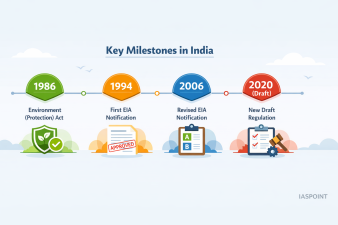
Key Milestones in India
- 1986: Enactment of the Environment (Protection) Act (EPA), providing the legal framework for EIA.
- 1994: The first EIA Notification was promulgated, making environmental clearance mandatory for 29 categories of activities.
- 2006: A revamped EIA Notification was issued, decentralizing the process and categorizing projects based on their magnitude and impact.
- 2020 (Draft): A new draft was introduced to streamline processes, though it remains a subject of intense environmental debate regarding “post-facto” clearances.
The Statutory Framework and Categorization
The EIA process in India is governed by the EIA Notification of 2006. This notification classified developmental projects into two distinct categories based on their scale and the nature of their impact.
| Feature | Category A Projects | Category B Projects |
| Clearance Level | Central Government (Ministry of Environment, Forest and Climate Change – MoEFCC) | State Government (State Environment Impact Assessment Authority – SEIAA) |
| Assessment Body | Expert Appraisal Committee (EAC) | State Level Expert Appraisal Committee (SEAC) |
| Requirement | Mandatory EIA report and Public Consultation | Divided into B1 (Requires EIA) and B2 (No EIA required) |
| Examples | Nuclear power, Large-scale mining, Ports, Highways | Small-scale industries, Minor mineral mining, Small town planning |
The 8-Step EIA Process in India
The methodology for conducting an EIA follows a standardized sequence to ensure transparency and scientific rigor.
1. Screening
This initial stage determines whether a project requires a full EIA based on its scale, location, and the type of industry. Category B2 projects are generally screened out of the formal EIA process.
2. Scoping
The Expert Appraisal Committee (EAC) defines the “Terms of Reference” (ToR). This specifies the physical and geographical boundaries of the study and the specific environmental parameters to be monitored.
3. Baseline Data Collection
This involves gathering primary and secondary data on the existing environmental status of the study area, including air quality, water tables, biodiversity (flora/fauna), and socio-economic conditions of the local population.
4. Impact Prediction and Mitigation
Experts quantify the potential changes the project might cause. This includes “Alternative Analysis” to evaluate different sites or technologies. A Mitigation Plan is then developed to minimize adverse effects.
5. Environment Management Plan (EMP)
The EMP is a detailed plan for the implementation, monitoring, and maintenance of the mitigation measures during the construction and operational phases of the project.
6. Public Hearing (Public Consultation)
A mandatory step for most projects where residents and stakeholders are informed about the project. The State Pollution Control Board (SPCB) conducts this process to record public concerns and objections.
7. Appraisal
The EAC or SEAC scrutinizes the final EIA report and the outcomes of the public hearing. They provide a recommendation for “Grant” or “Rejection” of the Environmental Clearance (EC).
8. Post-Project Monitoring
Ensures that the project proponent adheres to the conditions laid down in the Environmental Clearance. Proponents must submit half-yearly compliance reports.
Strategic Significance of EIA
- Sustainable Development: It balances the “Right to Development” with the “Precautionary Principle” and the “Polluter Pays Principle.”
- Biodiversity Conservation: Identifies if projects overlap with Eco-Sensitive Zones (ESZ), National Parks, or Wildlife Sanctuaries.
- Risk Reduction: Helps in identifying potential disasters, such as chemical leaks or dam failures, through Disaster Management Plans included in the EIA.
- Social Inclusion: Through public hearings, it empowers marginalized communities and tribal populations to have a say in projects affecting their land and resources.
Key Facts and Trivia for UPSC Prelims
- Rio Summit 1992: Principle 17 of the Rio Declaration explicitly mentions EIA as a national instrument for activities likely to have significant adverse impacts.
- Article 51A(g): The Indian Constitution imposes a fundamental duty on citizens to protect and improve the natural environment.
- National Green Tribunal (NGT): The NGT acts as the primary judicial body where Environmental Clearances granted via the EIA process can be challenged.
- Post-Facto Clearance: This refers to granting approval to projects that have already started construction without an EC. The Supreme Court has generally held that such clearances go against the grain of environmental law.