

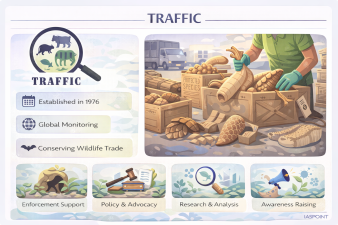
TRAFFIC (Trade Records Analysis of Flora and Fauna in Commerce) is a leading non-governmental organization (NGO) working globally on trade in wild animals and plants in the context of both biodiversity conservation and sustainable development. Established in 1976, it has evolved into a global network that monitors wildlife trade to ensure it does not threaten the survival of species.
Institutional Framework and Evolution
TRAFFIC was originally founded as a joint program between the World Wildlife Fund (WWF) and the International Union for Conservation of Nature (IUCN). While it remains a strategic partner to both, it is now an independent non-profit organization.
| Feature | Details |
|---|---|
| Founded | 1976 |
| Headquarters | Cambridge, United Kingdom |
| Legal Status | International NGO |
| Primary Focus | Monitoring and analyzing wildlife trade data |
| Relationship with CITES | Provides technical and objective evidence to the CITES Secretariat |
| India Office | Established in 1991, based in New Delhi (hosted by WWF-India) |
Core Mandate and Objectives
TRAFFIC operates at the intersection of trade, conservation, and livelihoods. Its mission is to ensure that trade in wild plants and animals is not a threat to the conservation of nature.
Key Functions
- Data Collection and Analysis: Maintaining the world’s most comprehensive database on wildlife trade patterns and seizures.
- Support to CITES: Acting as a bridge between scientific research and the policy decisions made by the Convention on International Trade in Endangered Species (CITES).
- Law Enforcement Support: Providing training and tools to customs officials, forest departments, and police to identify illegal wildlife products.
- Consumer Awareness: Running campaigns to reduce the demand for illegal wildlife products like ivory, rhino horn, and pangolin scales.
Major Initiatives and Tools
TRAFFIC has developed several specialized tools to combat wildlife crime and promote sustainable trade.
TIGER (Trade Information Gathering and Evaluation System)
A database used to track and analyze illegal trade in tiger parts, which is critical for the conservation of the species in Asia.
ETIS (Elephant Trade Information System)
TRAFFIC manages ETIS on behalf of CITES. It is a comprehensive database used to track illegal trade in ivory and other elephant products globally.
Wildlife Traps (W-TRAPS)
The Wildlife TRAPS Project (Trade Routes and Aid to Prevent Trafficking) focuses on strengthening the knowledge and partnerships needed to tackle illegal wildlife trade between Africa and Asia.
TRAFFIC in the Indian Context
The India office of TRAFFIC has been active since 1991 and works closely with the Ministry of Environment, Forest and Climate Change (MoEFCC).
- Operation Clean Art: Collaborative effort to crack down on the illegal trade in Mongoose hair brushes.
- Don’t Buy Trouble: A high-profile campaign aimed at tourists to prevent them from inadvertently purchasing illegal wildlife souvenirs.
- Wildlife Sniffer Dogs: TRAFFIC India helped pioneer the use of sniffer dogs (referred to as “Super Sniffers”) for the Forest Department to detect hidden wildlife contraband.
UPSC Prelims: Critical Facts and Trivia
- Distinction from CITES: CITES is an intergovernmental treaty (legally binding), whereas TRAFFIC is an NGO (non-binding). However, TRAFFIC’s data often forms the basis for CITES’ regulatory decisions.
- Red Sandalwood: TRAFFIC has frequently highlighted the illegal export of Red Sanders (Pterocarpus santalinus) from India, particularly to East Asia.
- Pangolin Trade: TRAFFIC identifies the Pangolin as the “world’s most trafficked mammal,” with significant volumes of the Indian Pangolin being illegally traded for its scales.
- FairWild Standard: TRAFFIC helped develop the FairWild Standard, which ensures that wild plant ingredients are harvested and traded in a way that is ecologically sustainable and socially fair.