
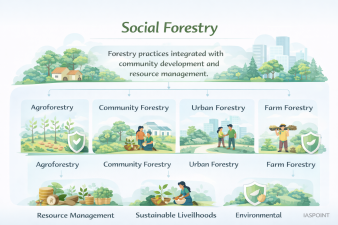
Social Forestry refers to the management and protection of forests and afforestation on barren lands with the purpose of helping environmental, social, and rural development. Unlike traditional forestry, which focuses on commercial timber extraction from state-owned forest lands, Social Forestry emphasizes the involvement of people to meet their own needs for fuelwood, fodder, and small timber.
- Origin of the Term: The term “Social Forestry” was first used in India in 1976 by the National Commission on Agriculture (NCA).
- Core Philosophy: It aims at taking the pressure off traditional forest areas by growing trees on all available lands outside the forest boundaries.
Components of Social Forestry
The National Commission on Agriculture (1976) classified social forestry into three distinct categories based on the location and purpose of the plantation.
Farm Forestry
In this component, individual farmers are encouraged to plant trees on their own farmland for commercial or non-commercial purposes.
- Objectives: To provide shade for crops, windbreaks, and a source of additional income through the sale of timber and pulpwood.
- Examples: Planting Eucalyptus, Poplar, or Subabul on the boundaries of agricultural fields.
Community Forestry
This involves the raising of trees on community or public lands such as village common lands, temple lands, and pasture lands.
- Ownership: The community as a whole owns and manages the plantation, and the benefits are shared among the villagers.
- Goal: To provide fodder and fuel for the entire community, particularly the landless poor.
Extension Forestry
This involves planting trees on the sides of roads, canals, and railway lines, as well as on waste lands.
- Scope: It creates “Linear Plantations” and increases the green cover in areas devoid of natural forests.
- Sub-type: Mixed Forestry, which includes raising fodder grass and fruit trees on communal land.
Objectives of Social Forestry Programs
- Environmental Restoration: Increasing tree cover to prevent soil erosion and improve the local micro-climate.
- Fuelwood Security: Providing an alternative source of cooking fuel to reduce the dependence on cow dung (which can then be used as manure) and natural forests.
- Fodder Supply: Improving the supply of green fodder for livestock to prevent overgrazing in sensitive forest zones.
- Rural Employment: Creating jobs through nursery management, planting, and harvesting activities.
- Reclamation of Wastelands: Utilizing alkaline, saline, or waterlogged soils that are otherwise unfit for agriculture.
Comparison: Traditional Forestry vs. Social Forestry
| Feature | Traditional Forestry | Social Forestry |
| Location | Reserved/Protected Forest Lands | Farm, Community, and Wastelands |
| Primary Goal | Revenue and Timber Production | Social, Rural, and Ecological Needs |
| Agency | State Forest Department (Top-down) | Local People/Panchayats (Bottom-up) |
| Benefit Sharing | State Revenue | Direct use by local communities |
| Species | Long-rotation timber (Teak, Sal) | Fast-growing species (Bamboo, Neem, Acacia) |
UPSC Prelims: Critical Facts and Trivia
- National Commission on Agriculture (1976): The pivotal body that recommended Social Forestry as a solution to India’s forest crisis.
- World Bank Support: During the 1980s, several Social Forestry projects in India were heavily funded by the World Bank and other international agencies like SIDA (Swedish International Development Authority).
- Van Mahotsav: Although started earlier in 1950 by K.M. Munshi, this annual tree-planting festival is a key cultural driver for the spirit of Social Forestry.
- Eucalyptus Controversy: A major criticism of early Social Forestry was the over-promotion of Eucalyptus. While fast-growing, it was criticized for depleting groundwater and providing little fodder or biodiversity value.
Benefits and Socio-Economic Impact
- Empowerment of Women: Since women are primarily responsible for collecting fuelwood and fodder, Social Forestry near villages directly reduces their physical drudgery.
- Check on Migration: By creating local wood-based industries and employment, it helps in reducing the distress migration of rural youth to urban centers.
- Soil Fertility: Leguminous trees (like Leucaena leucocephala) used in social forestry help in nitrogen fixation, thereby improving the soil quality of degraded lands.
Challenges in Implementation
- Survival Rates: Often, the “planting” phase is successful, but the “protection” phase fails due to lack of community interest or grazing by stray cattle.
- Land Use Conflicts: Competition between using common lands for grazing vs. using them for tree plantations.
- Bureaucratic Control: Despite being “social,” many projects remained under the tight control of forest officials, limiting the actual participation of the Gram Sabhas.