

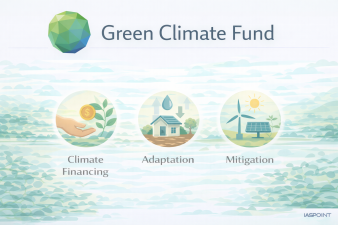
The Green Climate Fund (GCF) is the world’s largest dedicated multilateral fund helping developing countries reduce their greenhouse gas emissions and enhance their ability to respond to climate change.
- Establishment: Set up by the 194 countries who are parties to the United Nations Framework Convention on Climate Change (UNFCCC) in 2010.
- Context: Formally launched at COP 16 (Cancún, Mexico) and operationalized at COP 17 (Durban, South Africa).
- Headquarters: Songdo, Incheon, Republic of Korea.
- Legal Standing: It is an operating entity of the financial mechanism of the UNFCCC and serves the Paris Agreement (Article 9).
- Milestone (March 2026): At the 44th Board Meeting, the GCF total portfolio officially surpassed the $20 billion mark, covering over 350 projects globally.
Governance and Institutional Structure
The GCF is governed by a Board that is accountable to the Conference of the Parties (COP) of the UNFCCC.
- GCF Board: Consists of 24 members with equal representation from developed and developing countries.
- Trustee: The World Bank serves as the interim trustee (renewed through GCF-2 in 2023).
- Regional Presence (2026 Update): In a landmark 2026 decision, the GCF Board approved the establishment of regional offices. African regional offices will be located in Nairobi (Kenya) and Abidjan (Ivory Coast).
- Executive Leadership: Led by an Executive Director (currently Mafalda Duarte).
Funding and Replenishment Cycles
GCF relies on voluntary contributions from developed countries, as well as some developing countries, regions, and cities.
| Cycle | Period | Status / Pledges |
| IRM (Initial Resource Mobilization) | 2015–2019 | $9.3 Billion |
| GCF-1 (First Replenishment) | 2020–2023 | $10.0 Billion |
| GCF-2 (Second Replenishment) | 2024–2027 | ~$13.6 Billion (as of 2026) |
| GCF-3 | 2028–2031 | Replenishment process to kick off in mid-2026. |
Core Strategies and Investment Criteria
The GCF aims for a 50:50 balance between mitigation (reducing emissions) and adaptation (responding to climate impacts).
- Allocation Floor: At least 50% of adaptation funding is ring-fenced for Vulnerable Countries, including Least Developed Countries (LDCs), Small Island Developing States (SIDS), and African States.
- Investment Criteria: Proposals are evaluated based on:
- Impact Potential: Contribution to the Fund’s objectives.
- Paradigm Shift Potential: Ability to catalyze impact beyond a one-off project.
- Sustainable Development Potential: Wider economic, environmental, and social benefits.
- Needs of Recipient: Vulnerability and financing needs of the country.
- Country Ownership: Alignment with national climate strategies (NDCs).
- Efficiency & Effectiveness: Economic and financial soundness.
Access Modalities
Countries can access GCF funds through “Accredited Entities” (AEs), which act as project managers and implementers.
- Direct Access: Through sub-national, national, or regional entities (e.g., NABARD in India).
- International Access: Through UN agencies, multilateral development banks (e.g., World Bank, ADB), or international NGOs.
- Readiness Programme: Provides up to $1 million per country per year to strengthen “National Designated Authorities” (NDAs) and help them develop project pipelines.
GCF and India
India is a significant partner of the GCF and has seen several high-impact projects approved between 2024 and 2026.
- Nodal Authority: The Ministry of Environment, Forest and Climate Change (MoEF&CC) acts as the National Designated Authority (NDA).
- Accredited Entities in India: NABARD, SIDBI, IDFC Bank, and Yes Bank.
- Recent Projects (2025–2026):
- BEACON INDIA (2025): SIDBI-led project to accelerate climate innovation and incubation for India’s NDCs.
- Climate Resilience in Agriculture (2025): NABARD project focusing on harnessing insurance for smallholder farmers.
- India Green Finance Facility (IGFF): An ADB-led project approved in late 2025 to scale up private sector climate investments.
- Coastal Resilience: Ongoing “Enhancing Climate Resilience of India’s Coastal Communities” project targeting 24 ecosystems across Odisha, Maharashtra, and Andhra Pradesh.
Critical Facts and Trivia
- Small Island Priority: GCF has established a specific “Pacific” regional office in 2026 to address the existential threat of sea-level rise for SIDS.
- Simplified Approval Process (SAP): A streamlined pathway for small-scale, low-risk projects (under $25 million GCF contribution) to ensure faster fund disbursement.
- Private Sector Facility (PSF): A dedicated division within GCF that uses “de-risking” instruments (guarantees, equity) to mobilize trillions in private capital for climate action.