

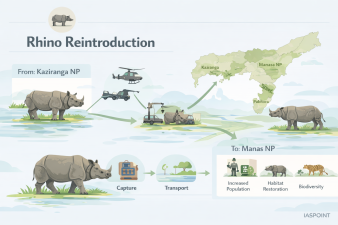
Rhino reintroduction is a conservation strategy involving the deliberate movement (translocation) of the Greater One-horned Rhinoceros (Rhinoceros unicornis) from high-density habitats to areas where they previously existed but were extirpated. This process is critical for reducing the risk of a single-point failure (extinction due to localized disease, flood, or poaching) and for restoring the ecological balance of grassland ecosystems.
Strategic Framework: National Rhino Conservation Strategy
Launched in 2019 by the Ministry of Environment, Forest and Climate Change (MoEFCC), this strategy provides the roadmap for reintroduction across India’s protected areas.
- Holistic Approach: It focuses on the “Greater One-Horned Rhino” across its entire range in India (Assam, West Bengal, and Uttar Pradesh).
- DNA Profiling: Integration of the Rhino DNA Index System (RhODIS) to ensure the genetic health of reintroduced populations.
- Transboundary Cooperation: Strengthening the “India-Nepal-Bhutan” rhino corridor to allow natural movement and genetic exchange.
Key Reintroduction Sites and Success Stories
India has executed several high-profile reintroduction programs that serve as global models for wildlife recovery.
| Reintroduction Site | State | Source Population | Current Status |
| Manas National Park | Assam | Kaziranga & Pobitora | Success: Population restored from zero (after 1990s unrest) to over 50 individuals. |
| Dudhwa National Park | Uttar Pradesh | Assam (1984) | Success: Established a stable breeding population in the Belaparsua range. |
| Valmiki Tiger Reserve | Bihar | Chitwan (Nepal) / Planned from Assam | Ongoing: Efforts to create a second “Rhino Conservation Area” (RCA) within the park. |
| Laokhowa-Burachapori | Assam | Kaziranga | Underway: Aims to reconnect the Kaziranga-Orang landscape. |
Process of Translocation
Translocation is a scientifically rigorous process that involves multiple stages to ensure the safety of the animal.
- Selection: Identifying healthy, young, or breeding-age adults (mostly sub-adults) to ensure high reproductive potential in the new site.
- Chemical Immobilization: Using tranquilizing guns with potent sedatives (like Etorphine or Azaperone).
- Logistics: Transporting the rhinos in specialized, reinforced crates via trucks, often escorted by security and veterinary teams.
- Soft Release: Sometimes rhinos are kept in a “boma” (enclosure) at the new site to acclimate to the environment before full release into the wild.
Major Challenges in Reintroduction
- Homing Instinct: Translocated rhinos often try to return to their original territory, leading them out of protected zones into human settlements.
- Habitat Suitability: Ensuring the new site has sufficient perennial water bodies and the specific grass species (Saccharum spontaneum) preferred by rhinos.
- Security Infrastructure: Reintroduction sites require intensive patrolling and anti-poaching camps before animals are brought in.
- Genetic Diversity: Ensuring that the founding population is not too closely related to avoid inbreeding depression.
Ecological Significance of Reintroduction
- Keystone Species: Rhinos are “architects of the grasslands.” By grazing on tall grasses, they create “grazing lawns” that allow smaller herbivores like the Hog Deer and Hispid Hare to thrive.
- Seed Dispersal: They play a vital role in dispersing the seeds of various plants through their dung, maintaining forest and grassland diversity.
- Trophic Cascade: Their presence supports a healthy predator-prey dynamic, providing a prey base (calves) for tigers and leopards.
Trivia for UPSC Prelims
- The 1984 Experiment: India’s first major rhino translocation took place in 1984 when rhinos were moved from Assam to Dudhwa National Park in Uttar Pradesh.
- Rhino Range States: India, Bhutan, Nepal, Indonesia, and Malaysia are the five rhino range states that signed the New Delhi Declaration (2019) for rhino conservation.
- Zero Poaching: In 2022, Assam achieved a landmark “Zero Poaching” record, largely attributed to the success of reintroduction monitoring and community involvement.
- World Rhino Day: Observed on September 22 to raise awareness about all five species of rhinos globally.