
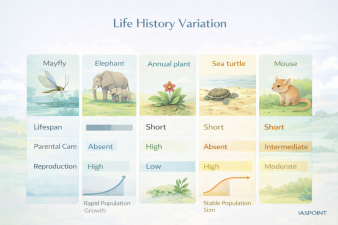
Life history variation refers to the diverse patterns of growth, survival, and reproduction that organisms use to maximize their evolutionary fitness. These variations are not random; they are strategic trade-offs dictated by the environment, resource availability, and the specific pressures of natural selection.
Core Components of Life History
Every organism has a “Life History Budget.” Since energy is finite, an organism must allocate it across four primary competing demands:
- Growth: Increasing body size and complexity.
- Maintenance: Repairing cells and maintaining immunity.
- Storage: Saving energy for future use (e.g., fat or starch).
- Reproduction: Producing offspring to ensure genetic continuity.
Key Patterns of Variation
Reproductive Frequency
Species vary in how many times they reproduce during their lifespan:
- Semelparity (Monocarpy in plants): Organisms reproduce only once in their lifetime and then die. This is often called “Big Bang” reproduction.
- Examples: Pacific Salmon, Bamboo, Century Plant (Agave), and many insects.
- Iteroparity (Polycarpy in plants): Organisms have multiple reproductive cycles throughout their life.
- Examples: Most mammals, birds, perennial trees (like Mango or Oak).
Clutch Size and Offspring Size
There is a fundamental inverse relationship between the number of offspring and the energy invested in each.
- Many Small Offspring: Strategies aimed at ensuring at least a few survive in unpredictable environments (e.g., Oysters producing millions of eggs).
- Few Large Offspring: Strategies focusing on high survival probability through greater nutrient investment or parental care (e.g., Cetaceans, Elephants).
Grime’s CSR Triangle (Plant Strategies)
In plant ecology, life history variation is often categorized into three strategies based on levels of stress and disturbance:
| Strategy | Environmental Condition | Traits | Example |
| Competitors (C) | Low Stress, Low Disturbance | Rapid growth, large size, high resource capture. | Forest Trees |
| Stress-tolerators (S) | High Stress, Low Disturbance | Slow growth, long-lived leaves, nutrient storage. | Lichens, Cacti |
| Ruderals (R) | Low Stress, High Disturbance | Short lifespan, high seed production, rapid maturity. | Weeds, Annual Grasses |
Age-Specific Mortality and Survivorship
Life history variations are reflected in Survivorship Curves, which plot the number of survivors against age.
- Type I: High survival during early/middle life; mortality increases in old age. Reflects high parental investment. (e.g., Humans, Hippopotamus).
- Type II: Constant mortality rate throughout the lifespan. (e.g., Hydra, some rodents, and birds).
- Type III: Massive mortality at the larval or seedling stage, with high survival for the few that reach adulthood. (e.g., Marine invertebrates, many fishes).
Determinants of Life History Evolution
Variation is driven by the interaction of several factors:
- Environmental Stability: Stable environments favor late maturity and fewer offspring (K-selection); unstable environments favor early maturity and many offspring (r-selection).
- Trophic Position: Predators often exhibit different life history traits compared to prey (e.g., prey often mature faster to reproduce before being eaten).
- Phylogenetic Constraints: Some variations are limited by the organism’s evolutionary history (e.g., all birds lay eggs regardless of their environment).
UPSC Prelims Perspective: Facts and Trivia
- The Cost of Reproduction: High current reproduction often leads to reduced future survival or lower future reproductive success. This is a central “cost” in life history theory.
- Parent-Offspring Conflict: A variation where the optimal investment for the parent (saving energy for future offspring) differs from the optimal investment for the current offspring (wanting more resources now).
- Phenotypic Plasticity: The ability of a single genotype to produce different life history traits in response to different environments (e.g., some fish maturing earlier if they sense high predator density).
- Ecological Niche and Strategy: Specialists usually exhibit narrow life history variation, while generalists show high plasticity to survive across diverse conditions.