

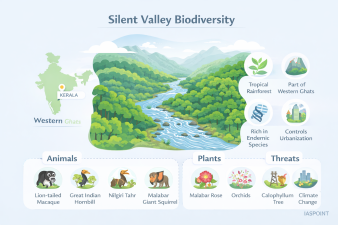
Silent Valley National Park, located in the Nilgiri Hills of Kerala, is one of the last undisturbed tracts of South Western Ghats mountain rain forests and tropical moist evergreen forests in India. Covering a core area of approximately 89.52 km2, it was formally declared a National Park in 1984 and inaugurated in 1985. It serves as the heart of the Nilgiri Biosphere Reserve, India’s first biosphere reserve.
Geography and Hydrography
The park is characterized by its unique “rectangular tableland” topography, shielded by high continuous ridges that create a distinct micro-climate.
- Location: Situated at the border of Palakkad and Malappuram districts in Kerala, bordering the Nilgiris district of Tamil Nadu.
- River Systems: The Kunthipuzha River, a major tributary of the Bharathapuzha, bisects the park from north to south. Its waters are famously crystal clear and perennial.
- Tributaries: Key tributaries of the Kunthipuzha include the Karingathodu, Madrimaranthode, and Valiaparathodu.
- Adjacent Protected Areas: It is contiguous with Mukurthi National Park (Tamil Nadu) to the northeast and Karimpuzha Wildlife Sanctuary (Kerala) to the north.
- Peaks: The highest point is Anginda Peak (2,383 m). Other significant peaks include Sispara and Mukurthi.
Biodiversity and Endemism
Silent Valley is globally recognized for its high level of endemism and is part of the Western Ghats World Heritage Site.
| Taxa | Diversity Facts |
| Flagship Species | Lion-tailed Macaque (Macaca silenus); the park hosts the largest viable population of this endangered primate. |
| Avian Diversity | A 2026 survey recorded 192 species, including rare migrants like the Asian House Martin and endemics like the Nilgiri Laughingthrush. |
| Flora | Features over 1,000 species of flowering plants and 100+ species of orchids. Dominant trees include Cullenia exarillata and Mesua ferrea. |
| Fauna Highlights | Nilgiri Langur, Malabar Giant Squirrel, Nilgiri Tahr (in higher reaches), and the Great Indian Hornbill. |
The “Save Silent Valley” Movement
This movement is a landmark in Indian environmental history, representing the first time a major developmental project was scrapped due to ecological concerns.
- Trigger: A proposal in 1973 by the Kerala State Electricity Board (KSEB) to build a hydroelectric dam across the Kunthipuzha River at Sairandhri.
- Key Actors: Led by the Kerala Sastra Sahitya Parishad (KSSP) and activists like poet Sugathakumari.
- Scientific Backing: The movement gained momentum when the ICAR identified the valley as a vital gene pool and the IUCN passed a resolution to protect the Lion-tailed Macaque habitat.
- Outcome: Prime Minister Indira Gandhi intervened in 1983, leading to the abandonment of the project and the eventual notification of the park.
Tribal Communities and Cultural Heritage
The park is home to four indigenous tribal groups whose traditional knowledge contributes to the conservation of the landscape.
- Irulas: Primarily known for their expertise in snake catching and honey collection.
- Kurumbas & Mudugas: Traditionally involved in shifting cultivation (within buffer zones) and NTFP collection.
- Kattunaikkars: Literally “Kings of the Jungle,” they are traditional forest dwellers with deep ethno-botanical knowledge.
Technical Trivia for UPSC Prelims
- The Name: It is called “Silent” because of the perceived absence of noisy Cicadas (insects), though recent surveys have confirmed their presence in certain pockets.
- Sairandhri: The local name for the valley, linked to the legend of Draupadi (Sairandhri) in the Mahabharata.
- Blue Carbon and Sequestration: The dense evergreen canopy makes it one of the most efficient carbon sinks in the Western Ghats.
- Buffer Zone: A 148 km2 buffer zone was formally approved in 2007 to protect the core area from illicit activities like poaching and ganja cultivation.
- Recent Discoveries: The 2026 bird survey noted breeding evidence for the Sri Lankan Frogmouth and sightings of the Black-and-Orange Flycatcher, confirming the park’s role as a stable breeding ground.