
The Millennium Development Goals (MDGs) were eight international development goals established following the Millennium Summit of the United Nations in 2000, following the adoption of the United Nations Millennium Declaration. All 189 United Nations member states and at least 22 international organizations committed to help achieve these goals by the year 2015.
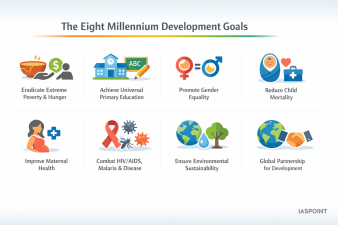
The Eight Millennium Development Goals
The MDGs provided a common framework for global development, focusing primarily on social indicators and poverty reduction.
| Goal Number | Title | Key Targets |
| Goal 1 | Eradicate Extreme Poverty and Hunger | Halve the proportion of people living on less than $1 a day and those who suffer from hunger. |
| Goal 2 | Achieve Universal Primary Education | Ensure that all boys and girls complete a full course of primary schooling. |
| Goal 3 | Promote Gender Equality and Empower Women | Eliminate gender disparity in primary and secondary education. |
| Goal 4 | Reduce Child Mortality | Reduce by two-thirds the under-five mortality rate. |
| Goal 5 | Improve Maternal Health | Reduce by three-quarters the maternal mortality ratio. |
| Goal 6 | Combat HIV/AIDS, Malaria and Other Diseases | Halt and begin to reverse the spread of HIV/AIDS and the incidence of malaria. |
| Goal 7 | Ensure Environmental Sustainability | Halve the proportion of people without sustainable access to safe drinking water. |
| Goal 8 | Develop a Global Partnership for Development | Address the special needs of least developed countries, including debt relief and aid. |
India’s Progress and Performance under MDGs
Significant Achievements
- Poverty Reduction (Goal 1): India met the target of halving the proportion of people living in extreme poverty well before the 2015 deadline.
- Gender Parity in Education (Goal 3): India achieved gender parity in primary and secondary education enrollment.
- Health Milestones (Goal 6): India successfully halted and reversed the spread of HIV/AIDS and was declared Polio-free in 2014.
Areas of Lag
- Maternal Mortality (Goal 5): While the Maternal Mortality Ratio (MMR) declined significantly, India missed the specific target of reducing it by three-quarters.
- Sanitation (Goal 7): Progress in providing access to basic sanitation was slower than the target, a factor that later led to the launch of the Swachh Bharat Mission.
Key Differences: MDGs vs. SDGs
The transition from MDGs (2000–2015) to SDGs (2016–2030) marked a shift in the global development philosophy.
| Feature | MDGs (2000-2015) | SDGs (2016-2030) |
| Scope | Focused mainly on social pillars (Poverty, Health, Education). | Holistic: Economic, Social, and Environmental pillars. |
| Applicability | Targeted primarily at developing and poor nations. | Universal: Applicable to all countries (Developed and Developing). |
| Number of Goals | 8 Goals with 21 Targets. | 17 Goals with 169 Targets. |
| Formulation | Top-down approach (Drafted by experts). | Bottom-up approach (Extensive global consultations). |
| Environmental Focus | Limited (only Goal 7). | Central (multiple goals dedicated to climate and planet). |
Critical Analysis and Legacy
The MDGs were criticized for being too narrow and for not addressing the root causes of poverty, such as inequality and environmental degradation. However, they were successful in:
- Mobilizing unprecedented global political support for development.
- Increasing official development assistance (ODA) from donor countries.
- Improving data collection and monitoring systems in developing nations.
Fact-File for UPSC Prelims
- The Millennium Declaration: Adopted in September 2000 at the UN Headquarters in New York.
- Baseline Year: The progress for MDGs was generally measured against the baseline year of 1990.
- Goal 8 Focus: Specifically dealt with the “North-South” cooperation, focusing on trade, debt relief, and technology transfer.
- Transition Point: The Rio+20 Conference in 2012 was the pivotal moment where the international community decided to transition from MDGs to a more comprehensive set of “Sustainable Development Goals.”