

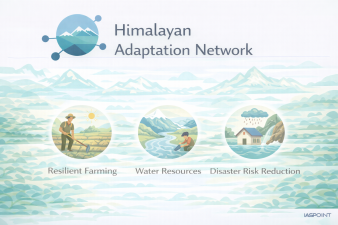
The Himalayan Adaptation Network (HIMAN) is a strategic regional initiative designed to foster collaboration, knowledge sharing, and capacity building for climate change adaptation across the Hindu Kush-Himalayan (HKH) region. It operates within the broader framework of the IUCN and works in synergy with national missions like India’s NMSHE to address the unique vulnerabilities of the “Third Pole.”
Core Objectives and Mandate
The network serves as a bridge between scientific research and field-level policy implementation.
- Knowledge Integration: Collating scientific data on glacier melt, water security, and biodiversity to create a unified regional database.
- Transboundary Cooperation: Facilitating dialogue between Himalayan nations (India, Nepal, Bhutan, etc.) to manage shared river basins and ecosystems.
- Capacity Building: Training local communities, NGOs, and government officials in Ecosystem-based Adaptation (EbA) techniques.
- Mainstreaming Policy: Ensuring that climate adaptation is integrated into the core developmental planning of Himalayan states and provinces.
Key Focus Areas (The 360° Approach)
| Focus Area | Key Interventions |
| Water Security | Rejuvenation of drying mountain springs (Springshed management) and monitoring glacial lake outburst floods (GLOFs). |
| Livelihoods | Promoting climate-resilient agriculture, high-value medicinal plant cultivation, and sustainable ecotourism. |
| Biodiversity | Mapping endemic species and creating biological corridors to allow species migration due to rising temperatures. |
| Disaster Risk | Developing community-based early warning systems (EWS) for landslides and flash floods. |
Synergy with India’s National Missions
HIMAN activities are closely aligned with the National Mission for Sustaining the Himalayan Ecosystem (NMSHE), one of the eight missions under India’s National Action Plan on Climate Change (NAPCC).
NMSHE vs. HIMAN Alignment
- NMSHE: Focuses on domestic institutional capacity, establishing State Climate Change Cells (SCCCs) in 12 Himalayan states (including the IHR).
- HIMAN: Provides the regional and international expertise, often collaborating with the G.B. Pant National Institute of Himalayan Environment (the nodal agency for NMSHE).
- Joint Outcome: The establishment of research stations like HIMANSH in Spiti Valley, Himachal Pradesh, which monitors high-altitude glaciers.
Ecosystem-based Adaptation (EbA) in the Himalayas
The network emphasizes EbA, which uses biodiversity and ecosystem services as part of an overall adaptation strategy.
- Example – “Ancestral Technologies”: Reviving traditional water harvesting structures and irrigation systems (like Kuhls in Himachal or Zing in Ladakh) to combat water scarcity.
- Nature-based Solutions: Using bio-engineering (planting specific grasses and shrubs) to stabilize slopes and prevent landslides instead of relying solely on concrete walls.
Critical Facts and Trivia for UPSC
- The “Water Tower” Concept: The network focuses on the Himalayas as the “Water Tower of Asia,” providing perennial water to nearly 1.3 billion people downstream.
- Gender Focus: The network specifically highlights the role of women as “first responders” and primary managers of mountain natural resources, advocating for gender-sensitive adaptation policies.
- Transboundary Sensitivity: Unlike many global networks, HIMAN must navigate complex geopolitical sensitivities, focusing primarily on technical and ecological cooperation.
- Knowledge Hubs: It utilizes a “Hub and Spoke” model, where central scientific institutions (Hubs) provide technical data to local community organizations (Spokes).
Recent Developments: Him-CONNECT
In 2026, the network’s objectives have expanded through initiatives like Him-CONNECT, which aims to bridge the gap between Himalayan scientific research and market-ready entrepreneurship. This focuses on translating research into “green enterprises” such as yak milk processing, silk waste utilization, and disaster-resilient housing techniques.
Last Modified: April 20, 2026