

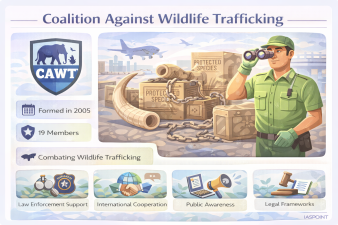
The Coalition Against Wildlife Trafficking (CAWT) is a unique voluntary public-private partnership aimed at ending the illegal trade in wildlife and wildlife products. Initiated by the United States Department of State in 2005, it functions as a global platform to mobilize political will and public awareness rather than acting as a formal regulatory body.
Institutional Framework and Evolution
Unlike CITES or the Gorilla Agreement, CAWT is not a treaty-based organization. It is a “coalition of the willing” that bridges the gap between governmental agencies and the private sector to tackle the illegal wildlife trade (IWT).
| Feature | Details |
|---|---|
| Established | September 23, 2005 |
| Initiating Body | U.S. Department of State |
| Status | Voluntary Public-Private Coalition |
| Membership | Open to Governments, NGOs, and Corporations |
| Secretariat | No permanent secretariat; administrative duties rotate with the Chair |
| Core Philosophy | Addressing both “Supply Side” and “Demand Side” simultaneously |
Strategic Goals and Action Areas
CAWT focuses on three primary pillars to disrupt the global wildlife trafficking network, which is estimated to be worth between $7 billion and $10 billion annually.
High-Level Political Will
- Diplomatic Engagement: Utilizing diplomatic channels to elevate wildlife crime from an “environmental issue” to a “transnational security and rule of law” issue.
- Inter-agency Cooperation: Encouraging countries to foster cooperation between customs, police, and environmental departments.
Law Enforcement Capacity
- Training and Technology: Supporting the development of regional wildlife enforcement networks (WENs), such as ASEAN-WEN (Association of Southeast Asian Nations Wildlife Enforcement Network).
- Cross-Border Intelligence: Facilitating the exchange of information to dismantle organized crime syndicates involved in drugs, weapons, and wildlife.
Demand Reduction
- Public Awareness: Executing global media campaigns to educate consumers on the link between wildlife products and species extinction.
- Corporate Responsibility: Partnering with shipping and e-commerce companies to block the online sale of illegal animal parts (e.g., ivory, tiger cubs).
Membership and Partners
The coalition comprises a diverse array of founding and current partners that provide technical and financial resources.
- Government Partners: Includes the United States, United Kingdom, India (joined in 2006), Australia, and Canada.
- NGO Partners: TRAFFIC, Conservation International, Wildlife Conservation Society (WCS), World Wildlife Fund (WWF), and the Smithsonian Institution.
- Business Partners: Industry groups like the American Forest & Paper Association and various online tech platforms.
CAWT in the Indian Context
India became a member of CAWT in 2006, aligning the coalition’s objectives with India’s domestic legal framework, specifically the Wild Life (Protection) Act, 1972.
- Collaboration: India works with CAWT to strengthen its Wildlife Crime Control Bureau (WCCB) through intelligence sharing.
- Capacity Building: Joint training programs with the US Fish and Wildlife Service for Indian customs and forest officials.
UPSC Prelims: Critical Facts and Trivia
- Voluntary Nature: CAWT is not legally binding. It complements CITES by providing the political and financial momentum that a formal treaty often lacks.
- Celebrity Advocacy: In 2008, CAWT launched a massive Public Service Announcement (PSA) campaign featuring actor Harrison Ford, reaching over 500 million people globally to reduce demand for illegal wildlife.
- Online Focus: A significant modern focus of the coalition is the Coalition to End Wildlife Trafficking Online, where tech giants like Google, Meta, and eBay work to remove prohibited wildlife listings using AI.
- Comparison with TRAFFIC: While TRAFFIC is a dedicated monitoring NGO that provides data, CAWT is a broader umbrella that includes governments and uses TRAFFIC’s data for political advocacy.